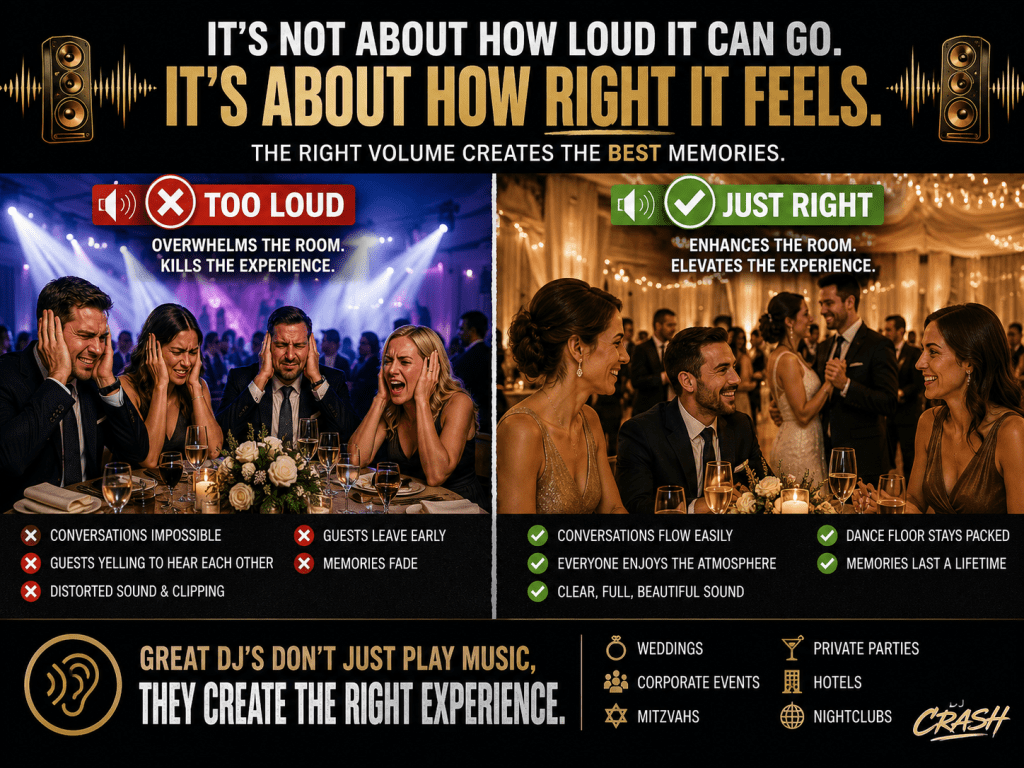
One of the biggest complaints I hear after attending an event has nothing to do with the food, the venue, or even the entertainment.
It’s almost always the same complaint:
“The music was too loud.”
After more than 30 years of DJing weddings, corporate events, hotels, private parties, mitzvahs, fundraisers, and nightclubs, I’ve come to one conclusion.
Most DJs play music too loud.
Not because the client asked them to.
Not because the guests wanted it.
Because they think louder equals better.
It doesn’t.
In my experience, volume is one of the most misunderstood parts of producing a successful event.
Every Event Has Its Own Soundtrack
One mistake I see over and over again is treating every part of an event the same.
Cocktail hour shouldn’t sound like a nightclub.
Dinner shouldn’t compete with conversation.
A networking reception shouldn’t require people to shout across the table.
Likewise, a packed dance floor shouldn’t feel like background music.
Every part of an event has its own purpose, and the sound level should support that purpose.
Music isn’t just entertainment.
It’s part of the atmosphere.
Start Lower Than You Think
One lesson I learned early in my career has stayed with me for decades.
You can always turn the music up.
It’s much harder to turn it down.
When guests arrive, they’re greeting friends, introducing family members, finding their seats, and getting comfortable. They don’t need concert-level volume.
Starting slightly lower gives you room to build the energy naturally throughout the evening.
If you begin at maximum volume, you’ve painted yourself into a corner. The only direction left is distortion, fatigue, and eventually guests walking away from the dance floor because they’re overwhelmed.
Energy should grow.
Volume should grow with it.
Loud Doesn’t Mean Powerful
This is one of the biggest myths in the entertainment industry.
Many people assume that louder music automatically creates more excitement.
The opposite is often true.
A properly tuned sound system playing at a comfortable level almost always sounds larger, richer, and more enjoyable than an overloaded system struggling to keep up.
Once speakers begin to distort, the music loses its warmth, vocals become harsh, and conversations become impossible.
Unfortunately, some DJs ignore this completely.
I’ve heard DJs whose microphones were clipping and distorting all night long.
I’ve heard sound systems pushed far beyond their limits.
To me, that’s not professionalism.
That’s ego, not art.
Walk the Room
One habit has served me well throughout my career.
I leave the DJ booth.
During cocktail hour, dinner, and dancing, I’ll periodically walk through the venue and listen from the guests’ perspective.
Why?
Because the room doesn’t sound the same everywhere.
What sounds balanced behind the DJ booth may be overwhelming near one speaker and too quiet in another part of the room.
Professional DJs don’t mix for themselves.
They mix for the audience.
That’s why I believe every DJ should walk the room several times during an event.
It’s one of the easiest ways to fine-tune the guest experience.
Every Venue Is Different
A ballroom filled with carpet, drapes, and people absorbs sound differently than a modern industrial venue with concrete floors and high ceilings.
Outdoor events behave differently than indoor receptions.
A hotel ballroom sounds different from a private residence.
That’s why there isn’t one “correct” volume.
An experienced DJ adjusts to the room rather than relying on the same settings every weekend.
The equipment may be similar.
The environment never is.
The Goal Is Comfort
People often assume that a successful dance floor has to be painfully loud.
It doesn’t.
Guests should feel the music.
They shouldn’t have to cover their ears.
The bass should have impact without overwhelming the room.
Vocals should remain clear.
Announcements should be easy to understand.
Good sound isn’t about making people notice the speakers.
It’s about making them notice the experience.
Volume Is Part of Event Design
When I meet with clients, we don’t just talk about playlists.
We talk about the flow of the evening.
Cocktail music should encourage conversation.
Dinner music should create atmosphere without becoming a distraction.
Open dancing should feel energetic and exciting.
As the night progresses, the volume naturally increases along with the excitement.
The sound should support what’s happening in the room, not fight against it.
The Best Compliment I Can Receive
One of my favorite compliments isn’t, “That was loud.”
It’s not, “Those speakers were incredible.”
It’s hearing guests say:
“We had so much fun.”
Or,
“The music was perfect all night.”
Notice what isn’t mentioned.
Nobody remembers the speaker brand.
Nobody remembers the decibel level.
They remember how they felt.
That’s exactly how it should be.
Final Thoughts
Whether you’re hosting a wedding, corporate event, fundraiser, gala, birthday celebration, hotel reception, or private party, remember this:
Music should enhance the experience, not dominate it.
A professional DJ understands when to create excitement, when to encourage conversation, and when to simply let the room breathe.
After more than three decades of performing at thousands of events, I’ve learned that the best sound system isn’t the loudest one.
It’s the one people hardly notice because it feels so natural.
That’s what great sound should do.
It shouldn’t call attention to itself.
It should quietly create unforgettable memories.
— DJ Crash
30+ Years of Professional DJ Experience
Corporate Events • Weddings • Hotels • Mitzvahs • Private Parties • Nightclubs


