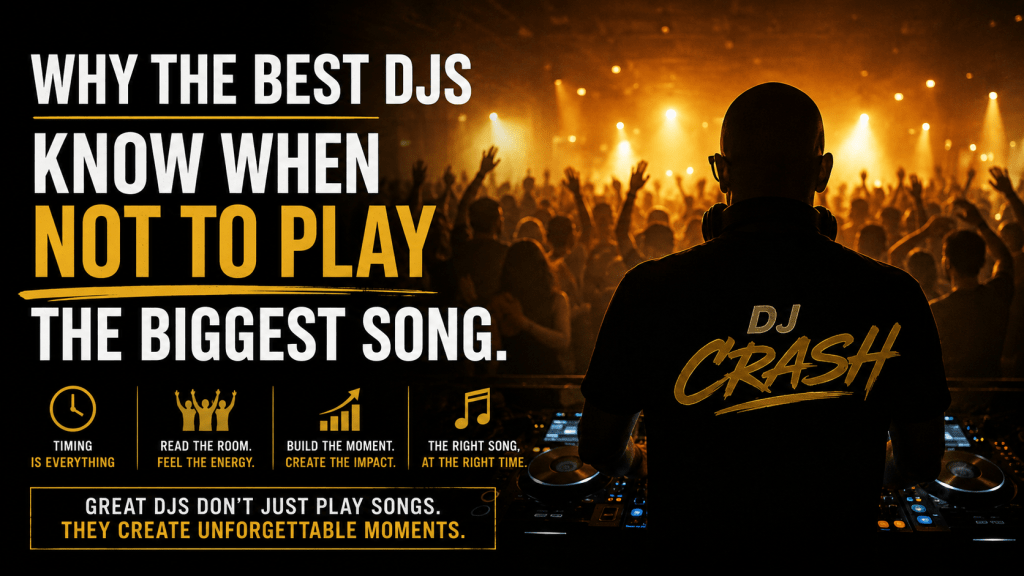
One of the hardest lessons to learn as a DJ is also one of the simplest:
Just because you have the perfect song doesn’t mean it’s the perfect time to play it.
After more than 30 years of DJing weddings, corporate events, hotels, private parties, mitzvahs, nightclubs, galas, and special events, I’ve learned that great DJing isn’t only about choosing great music.
It’s about timing.
You can play an incredible song at the wrong moment and get almost no reaction.
Play that exact same song 45 minutes later and the room can explode.
The song didn’t change.
The moment did.
And understanding that difference is one of the things that separates an experienced DJ from someone simply playing a collection of popular songs.
Every DJ Has “Big Records”
Whatever type of event you’re working, there are songs you know are almost guaranteed to get a reaction.
They change depending on the crowd.
At one event it might be a classic disco record.
At another it could be ’80s rock.
At another it’s hip-hop, house, pop, funk, Latin music, or a current hit.
These are the songs DJs know can produce a moment.
And that creates a temptation:
Play them immediately.
The dance floor opens, people start moving, and the DJ wants to prove they can make the party happen.
So out come the biggest songs.
One after another.
It can work.
For a while.
The problem is that you may be spending your best musical currency before the night has even developed.
Don’t Play Your Fourth-Quarter Music in the First Quarter
I sometimes think about DJing like sports.
You don’t use every play in the first quarter.
You need options later.
The same thing applies to music.
If I know there are certain records that can unite almost everyone in the room, I’m thinking carefully about when to use them.
Maybe I need one early to establish the dance floor.
But I probably don’t need five.
I want the night to have somewhere to go.
A great party should feel like it’s getting better.
Not like it peaked 25 minutes after dancing started.
A Great Song Is Not Automatically a Great DJ Decision
This is an important distinction.
People sometimes evaluate DJs based on the individual songs they hear.
“I love this song.”
That’s great.
But DJing isn’t a collection of individual songs.
It’s the relationship between them.
What happened before this song?
Where is the energy now?
Who’s on the dance floor?
Who’s waiting to join?
What does the room need next?
What am I trying to accomplish 20 minutes from now?
Those questions matter.
Sometimes the obvious hit is exactly what the room needs.
Sometimes playing the obvious hit is the laziest possible decision.
The Dance Floor Has an Energy Curve
A dance floor isn’t either “full” or “empty.”
There are dozens of levels in between.
Maybe 20 people have started dancing.
Then 35.
Then 60.
Then almost everyone.
Those stages require different decisions.
If a small group is beginning to create its own energy, I don’t necessarily want to overwhelm the moment with the biggest song of the night.
I might want to give them something that keeps them moving.
Then another.
Then something more recognizable.
Then something that brings another demographic onto the floor.
Now we’re building.
And when the room is finally ready?
That’s when the big record becomes much more powerful.
Anticipation Is Part of Entertainment
People enjoy anticipation.
It’s why movies don’t reveal everything in the opening scene.
It’s why concerts don’t usually begin with the encore.
It’s why great meals don’t start with dessert.
There’s pleasure in progression.
Events work the same way.
Guests might not consciously realize that the music is building.
But they feel it.
The tempo might increase.
The familiarity might increase.
The songs might become more celebratory.
The transitions might tighten.
The dance floor begins feeling less like several groups of people and more like one crowd.
Then you deliver something everybody recognizes.
That’s a moment.
The Song Before the Song Is Often More Important
One of the things I’ve learned over decades of DJing is that sometimes the most important song isn’t the big song.
It’s the record immediately before it.
That song prepares the audience.
Maybe it brings the tempo into the right range.
Maybe it shifts generations.
Maybe it introduces a familiar musical style.
Maybe it gets people singing.
Maybe it simply creates tension.
Then the next song arrives and feels inevitable.
People think:
“Of course!”
That’s one of my favorite reactions.
The DJ didn’t simply play a hit.
The DJ created the conditions that allowed the hit to become a moment.
Weddings Are a Perfect Example
Weddings can include several generations of guests.
You might have people in their 20s dancing alongside people in their 70s.
That creates enormous opportunities—but it also requires patience.
If I immediately play every universal wedding favorite, I may get a fantastic early response.
But what happens later?
Instead, I might use one crossover record to bring generations together.
Then move into something for the younger crowd.
Later, reconnect everyone with another universal record.
Now the dance floor has peaks and valleys.
It breathes.
That’s much more interesting than simply playing every guaranteed crowd-pleaser consecutively.
Corporate Events Require Even More Patience
Corporate events can be tricky because the audience doesn’t always arrive expecting to dance.
People might be networking.
They might be entertaining clients.
They might have spent the entire day in meetings.
They may not know each other socially.
If you attack that audience with peak-hour nightclub music immediately, you can actually make people retreat.
Instead, I want to create permission.
The music becomes more energetic.
Someone starts moving.
A small group gathers.
People recognize a song.
The room loosens up.
Eventually the audience tells me:
We’re ready.
That’s when I can push harder.
Luxury Events Reward Restraint
Working in luxury hospitality taught me something valuable:
Not every moment needs to be maximized.
Sometimes the room is exactly where it should be.
People are drinking.
Talking.
Laughing.
The atmosphere feels fantastic.
A less experienced DJ might think:
“I need to get everyone dancing.”
Why?
Maybe you don’t.
Maybe your job at that moment is to protect what’s already working.
That’s where restraint becomes a professional skill.
Knowing what to play is important.
Knowing when to leave the room alone can be even more important.
Don’t Confuse a Full Dance Floor With a Successful Event
This may sound strange coming from a DJ, but I don’t judge every event by whether every person is dancing.
Different events have different objectives.
At a nightclub, the dance floor may be everything.
At a wedding, dancing is usually a major part of the celebration.
At a corporate reception, networking may be equally important.
At a hotel rooftop, guests might want cocktails, conversation, atmosphere, and some dancing.
Success depends on understanding the assignment.
The biggest song in your library isn’t useful if it fights against the purpose of the event.
Requests Can Create Timing Problems
Sometimes a guest requests a fantastic song.
They may even be right.
It’s a great choice.
But it isn’t right yet.
That’s one reason I don’t automatically play requests immediately.
If someone asks for a huge singalong record during dinner, playing it might waste what could become an incredible moment later.
I haven’t rejected the request.
I’ve stored the information.
Now I know someone wants it.
Maybe several people do.
When the room reaches the right place, I’ll use it.
And the person who requested it will probably think:
“The DJ played my song!”
They don’t need to know I waited an hour because I was protecting the moment.
Experience Creates Patience
When you’re starting out as a DJ, silence can feel dangerous.
A thinning dance floor feels dangerous.
A song that isn’t getting a massive reaction feels dangerous.
So you react.
Quickly.
Change songs.
Change genres.
Play something bigger.
Grab the microphone.
Do something.
Experience teaches you that sometimes the best decision is:
Don’t panic.
Dance floors breathe.
People get drinks.
People go to the restroom.
People talk.
Then they return.
A DJ who panics every time five people leave the dance floor will eventually destroy the musical flow.
Technology Knows the Song. It Doesn’t Know the Moment.
Modern DJ software is incredible.
It can organize music.
Analyze BPM.
Identify musical keys.
Recommend related songs.
Streaming services can tell you what’s popular.
Algorithms can build playlists based on millions of listening patterns.
That’s useful.
But none of those tools are standing in the room.
They don’t see the grandmother who just joined the dance floor.
They don’t notice the group of executives finally loosening their ties.
They don’t see the bride looking toward her college friends.
They don’t notice 20 people at the bar suddenly singing the chorus.
The DJ does.
That’s why the human element still matters.
Sometimes You Save a Song and Never Play It
This might be the ultimate test of restraint.
There are nights when I have a song ready that I know could work.
And I never play it.
Why?
Because the night went somewhere else.
Maybe another musical direction became stronger.
Maybe we ran out of time.
Maybe the crowd found its own unexpected identity.
That’s okay.
My job isn’t to demonstrate how many great songs I brought.
My job is to create the best experience possible.
If the night doesn’t need the song, the song doesn’t get played.
Great DJing Is About Creating Moments, Not Checking Boxes
There is no prize for playing every song on a list.
There is no prize for fitting 100 songs into four hours.
Guests don’t go home counting tracks.
They remember moments.
The song everyone unexpectedly sang together.
The record that brought the older generation back onto the dance floor.
The track that suddenly turned a corporate reception into a party.
The last song when nobody wanted the night to end.
Those moments feel spontaneous.
But often they’re the result of patience.
Final Thoughts: The Right Song at the Wrong Time Is the Wrong Song
If you’re hiring a DJ for a wedding, corporate event, hotel reception, gala, mitzvah, private party, or special event, don’t just ask:
“What songs will you play?”
Ask how they decide when to play them.
That’s a much more revealing question.
After more than three decades behind the decks, I’ve learned that having great music is only the beginning.
You have to understand the audience.
You have to understand pacing.
You have to understand anticipation.
And sometimes you have to resist playing the song you know will work because you know it will work even better later.
Great DJs don’t simply know the biggest songs.
They know when the room has earned them.
— DJ Crash
30+ Years of Professional DJ & Event Experience
Weddings • Corporate Events • Hotels • Mitzvahs • Private Parties • Nightclubs • Luxury Events


