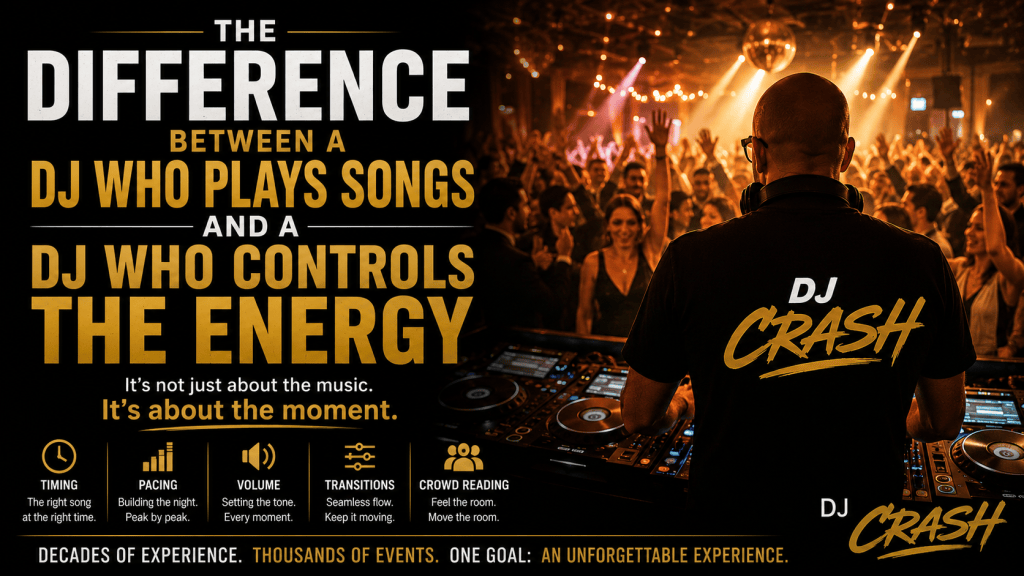
Anyone can play a song. That statement probably sounds strange coming from someone who has spent more than 30 years as a professional DJ, but it has never been more true. Today, almost everyone has instant access to millions of songs. A laptop can organize them, software can match tempos and musical keys, streaming services can generate playlists, and algorithms can recommend what comes next. But none of those things automatically create a great event, because the real job of a professional DJ isn’t simply to play music. It’s to control energy.
I’ve DJed weddings, corporate events, hotels, rooftops, private parties, mitzvahs, nightclubs, galas, celebrity events, and large-scale functions throughout my career. The environments may be completely different, but the fundamental challenge is always the same: What does this room need right now, and where do I want to take it next? That’s the difference between playing songs and actually DJing.
Song Selection Is Only the Beginning
A DJ obviously needs good music. You need a deep library, knowledge of different eras and genres, and an understanding of what songs work for different audiences. But knowing great songs is really just the entry requirement. It’s not the entire profession. Give two DJs exactly the same 500 songs and you’ll probably get two completely different parties. One might play recognizable hit after recognizable hit and still struggle to create momentum, while the other might use those exact same records to gradually build a room until the dance floor feels unstoppable.
The reason is simple: songs don’t exist independently during an event. Every song changes the environment for the song that follows it. A great DJ is thinking beyond the record currently playing and considering what it is doing to the audience, what should happen next, and where the room could be 15 or 30 minutes from now.
Energy Is Something You Build
One of the biggest mistakes I see in event entertainment is the assumption that more energy is always better. It isn’t. The goal isn’t maximum energy for five straight hours. The goal is the right energy at the right time. Think about a great movie. Every scene isn’t an explosion. There are quiet moments, tension, anticipation, surprises, and eventually peaks. Those changes are what make the biggest moments actually feel big.
Music works the same way. If I start an event at maximum intensity, I’ve left myself nowhere to go. I’d rather establish the room, understand the audience, build trust, and gradually raise the temperature. By the time we reach the peak of the night, guests should feel like they arrived there naturally rather than having the energy forced upon them.
The Dance Floor Tells You More Than Your Laptop
DJ software gives me an extraordinary amount of information. I can see BPM, musical key, waveforms, cue points, track history, and playlists. But the most important information isn’t on my screen. It’s standing in front of me. I’m constantly watching who’s walking onto the dance floor, who’s leaving, which age groups are responding, who’s singing every word, whether people are dancing individually or beginning to dance together, whether guests sitting at tables are starting to watch the dance floor, and whether people are leaving the bar because something happening musically has caught their attention.
Those are signals, and they can tell me far more than a computer screen. A DJ who spends the entire night staring at a laptop is missing a huge part of the job. Technology tells you what’s happening inside the music. The room tells you what’s happening to the people.
Knowing When to Push—and When to Pull Back
There are moments when a room is clearly ready for more. The dance floor begins filling, people start singing, and guests react faster as soon as they recognize a song. That’s when I might increase the tempo, tighten the transitions, move toward more recognizable records, introduce something with a bigger chorus, or shift into a genre that I know will bring another group onto the floor. I’m pushing the room, but I’m not forcing it. There’s an important difference. The audience has already given me permission.
Knowing when to pull back is just as important. A dance floor can become exhausted. If every record is huge, every transition is aggressive, and every moment demands maximum attention, people eventually need a break. That doesn’t necessarily mean clearing the dance floor. Sometimes a slight reduction in intensity is enough. A familiar singalong, a groove that gives people room to breathe, or a song that’s fun without demanding maximum physical energy can provide a small reset. Then you can begin climbing again. Those peaks and valleys can extend a successful party dramatically.
A Full Dance Floor Isn’t Always the Objective
This becomes especially important outside traditional nightlife. At a wedding, dancing is usually a major part of the celebration. At a nightclub, the dance floor may be the primary focus. But a hotel rooftop, corporate reception, luxury cocktail party, product launch, or brand activation may have completely different objectives. People might need to network, clients may be talking business, and guests may simply want cocktails, conversation, and a great atmosphere.
The music still needs energy, but it doesn’t necessarily need to demand participation. That’s where music direction becomes different from conventional dance-floor DJing. Sometimes controlling energy means making a room feel vibrant without making anyone feel like they’re supposed to dance.
Corporate Events Require Emotional Intelligence
Corporate events have taught me a great deal about energy management because you can have hundreds of people in a beautiful venue with an incredible production setup and still have a room that needs time. Guests may have just finished a conference, they may be meeting colleagues from other offices, executives may be entertaining clients, and some people may be ready to party while others aren’t.
Trying to turn that environment into a nightclub before guests are ready can actually reduce engagement. Instead, I want to understand what the room is doing. Let people arrive. Let conversations develop. Make the atmosphere feel good. Then start introducing more musical personality. If dancing is part of the objective, eventually the transition begins. When it’s done correctly, guests barely notice it happening. Suddenly a networking reception has naturally become a party.
Weddings Are About Multiple Energy Levels
Weddings present a completely different challenge because you might have an eight-year-old and an 80-year-old on the same dance floor. That’s fantastic, but those guests don’t necessarily respond to the same music for the same reasons. One generation might react to nostalgia, another to something current, and another to a song because their parents played it when they were growing up.
A good wedding DJ isn’t simply rotating genres every few songs. They’re finding connections between generations. That means understanding when to shift, when to stay with something that’s working, when to use a crossover record, when to introduce something younger, and when to bring everyone back together. You’re managing several different energy levels simultaneously while trying to make the entire room feel like one celebration.
Volume Is Energy Too
Energy isn’t created only through song selection. Volume matters enormously. Play great music too loudly during dinner and you’ve created the wrong energy. Guests can’t talk, people become uncomfortable, and the music starts competing with the event instead of supporting it. On the other hand, music that’s too quiet can make a large room feel empty.
The right volume changes throughout the evening. Arrival, cocktails, dinner, dancing, and late night each have different requirements. Professional sound isn’t about proving how loud the system can go. It’s about making the room feel right. I believe one of the most important things a DJ can do is actually walk around the venue during an event and listen to the sound from the guests’ perspective. What sounds perfect behind the booth may be completely different 50 feet away.
The Microphone Changes Energy Instantly
The microphone is another tool that needs restraint because the moment a DJ speaks, attention shifts. That’s powerful, and precisely because it’s powerful, I don’t believe it should be used unnecessarily. Sometimes the room needs direction: an introduction, an announcement, a transition, or perhaps a call to the dance floor. In those situations, the microphone serves a purpose.
Constant shouting doesn’t automatically create excitement. In many environments it destroys the atmosphere you’re trying to build. I’ve always preferred letting the music do as much of the communication as possible. If I can musically move a crowd in the direction I want them to go, I don’t need to constantly tell them what to do.
Transitions Matter More Than People Realize
Guests may not consciously notice a great transition, and that’s usually a compliment. The energy simply continues. Poor transitions, however, are immediately noticeable. A room might be dancing comfortably at one tempo and suddenly the next song feels completely disconnected. A genre shift arrives without preparation, or a high-energy record is followed by something that collapses the momentum.
Those changes affect people emotionally even when they can’t explain exactly why. A transition isn’t only technical. It’s psychological. You’re essentially telling the audience, “We’re going somewhere else now.” The question is whether you’ve prepared them enough that they’re willing to follow you.
Knowing When to Change Direction Is Critical
Sometimes a musical direction works, and sometimes it doesn’t. One of the worst things a DJ can do is become emotionally attached to their own plan. Maybe I thought a particular style would connect with the crowd and it didn’t. That’s useful information. Change direction. A DJ shouldn’t be trying to prove that their musical taste is correct. The audience doesn’t care. They care about having a great time.
Flexibility is one of the most important tools I have. At the same time, you can’t panic. If three people leave the dance floor, that doesn’t necessarily mean the song failed. Maybe they’re getting drinks, maybe they’re tired, or maybe they’re going outside for a few minutes. Dance floors breathe. Experienced DJs learn the difference between a natural fluctuation and a genuine loss of momentum. If you react dramatically every time the room changes slightly, you’ll eventually create musical chaos. Sometimes controlling the energy means trusting what’s already working.
The Biggest Song Isn’t Always the Answer
If the room dips slightly, the answer isn’t always to immediately play the biggest hit you have. That may solve the problem temporarily, but now you’ve used one of your strongest records. Sometimes the better decision is to rebuild. Give the audience something familiar, reconnect with them, and then start climbing again.
A huge record is far more effective when the room is prepared for it. That’s why timing matters so much. The right song at the wrong moment can effectively become the wrong song. An experienced DJ understands not only which songs are powerful, but when that power will have the greatest impact.
Great DJs Create Peaks and Valleys
Some moments during an event should feel bigger than others. The first major dance-floor moment, an unexpected song, a generational crossover, a huge singalong, the late-night peak, or the final record can all become memories. If every song is treated like the climax, none of those moments feel particularly special.
I want people to remember moments. That’s why pacing matters. You’re not simply filling four or five hours with music. You’re shaping the emotional experience of the evening. The peaks become more meaningful because there were valleys before them, and sometimes giving a room a little space is exactly what allows the next moment to become unforgettable.
This Is Where Experience Matters
After thousands of events, you begin recognizing patterns. I don’t mean formulas, because every audience is different. I mean patterns. You learn when a room is about to move. You learn when people need another familiar song. You recognize when a crowd is ready for something unexpected. You can sense when a dance floor needs to breathe. You know when the volume should change, when the microphone isn’t necessary, and when your original plan needs to be abandoned.
That judgment is difficult to teach because much of it comes from thousands of hours of watching audiences respond in real time. It’s also why experience matters so much in private events. You don’t necessarily know what will happen during a wedding, corporate function, mitzvah, gala, or nightclub event until it happens. Experience gives you a much larger collection of possible solutions when something unexpected occurs.
Technology Can Assist, but It Can’t Feel
We’re entering an era where AI can generate music, build playlists, analyze preferences, and recommend songs with remarkable accuracy. I think those tools will continue getting better, and I have no problem with technology. I’ve watched DJ technology transform repeatedly throughout my career, and I’ve adapted with it.
But an algorithm doesn’t stand behind the DJ booth looking at 300 people. It doesn’t notice that the CEO who hadn’t danced all night just loosened his tie and started walking toward the dance floor. It doesn’t see three generations of a family suddenly gathering together. It doesn’t notice a group at the bar singing along with a song they clearly love. Most importantly, it doesn’t feel that moment when a room is ready to explode.
A human DJ does. That’s why I believe the future of professional DJing will depend less on access to music and even more on judgment. Everyone has access to songs now. Not everyone knows what to do with a room.
The Best DJs Make It Look Easy
When everything is working, guests shouldn’t be analyzing any of this. They shouldn’t be thinking about energy curves, transitions, demographics, volume, song sequencing, or pacing. They should simply be enjoying themselves.
Behind the booth, I’m constantly making decisions. In front of the booth, it should simply feel like a great night. That’s one of the strange things about doing this job well: the more experience you have, the less complicated you often want the event to feel. The work happens behind the scenes so the experience can feel effortless.
Final Thoughts: Don’t Just Play Music. Move the Room.
If you’re hiring a DJ for a wedding, corporate event, hotel, private party, mitzvah, gala, brand activation, or nightclub, don’t only ask about their music library. Almost every professional DJ today has access to great music. Instead, ask how they read an audience. Ask how they handle a mixed-age crowd. Ask how they approach cocktails versus dancing. Ask what they do when the dance floor changes. Ask how they manage volume. Ask how flexible they are when the timeline or musical direction suddenly changes.
Those questions tell you much more about the experience you’re actually hiring. After more than three decades behind the decks, I’ve learned that the greatest DJs aren’t necessarily the people who know the most songs. They’re the people who understand what those songs do to people.
A DJ plays music. A great DJ moves the room.
— DJ Crash
30+ Years of Professional DJ & Event Experience
Weddings • Corporate Events • Hotels • Rooftops • Mitzvahs • Private Parties • Nightclubs • Luxury Events


