By DJ Crash | Crash Entertainment
After more than 30 years DJing corporate events, weddings, galas, conventions, nightclubs, and private celebrations, I’ve learned that one of the most important elements of a successful event is something guests rarely think about.
The transitions.
Everyone remembers a great speech, an incredible dinner, or a packed dance floor. But what connects those moments can determine whether an event feels polished and professional or awkward and disorganized.
I’ve worked events where the entertainment was excellent, the venue was beautiful, and the guests were enthusiastic, yet the evening never quite developed the momentum it should have.
Often, the problem wasn’t the individual elements.
It was how those elements connected.
A successful event isn’t simply a collection of activities. It’s a carefully managed experience, and the music plays a much bigger role in that process than most people realize.
Every Event Has a Natural Rhythm
I approach event programming much like I approach a DJ set.
There needs to be a beginning, development, moments of anticipation, peaks of energy, and opportunities for guests to relax.
A corporate event might begin with a cocktail reception, transition into dinner, move through speeches or awards, and eventually become a celebration.
Each phase has a different purpose.
Cocktails encourage conversation and networking. Dinner creates an opportunity for guests to connect. Speeches and presentations require attention. Dancing allows everyone to relax and celebrate.
The challenge is moving between those experiences without making the evening feel disconnected.
That’s where music direction becomes essential.
Cocktail Hour Sets the Tone
The cocktail reception is the first opportunity to establish the event’s personality.
I don’t believe in beginning every event with high-energy music simply because people are arriving.
For a corporate reception, I might select sophisticated house, funk, soul, contemporary lounge music, or recognizable songs presented in a more relaxed style.
The music should create atmosphere without interfering with conversation.
Volume is particularly important.
I’ve always believed that professional sound doesn’t necessarily mean loud sound. Guests should be able to speak comfortably while still enjoying the music.
As the cocktail reception approaches its conclusion, I can gradually adjust the musical energy to prepare guests for the next phase.
Sometimes that means introducing a slightly more recognizable song. Other times it means reducing the intensity as guests begin moving toward dinner.
The transition should feel natural.
Guests shouldn’t feel like one event has ended and an entirely different event has suddenly begun.
Dinner Music Requires Restraint
Dinner is one of the easiest portions of an event to mishandle.
I’ve seen DJs become so focused on keeping the energy high that they forget guests are eating, talking, and enjoying the company around them.
Dinner music should complement the experience, not dominate it.
That doesn’t mean the music has to be boring.
There are countless sophisticated selections across soul, jazz, R&B, funk, pop, and contemporary electronic music that can maintain an engaging atmosphere at a comfortable volume.
The key is understanding the room.
A formal awards dinner requires a different musical approach from a company holiday celebration.
An executive reception might benefit from understated selections, while a younger technology-industry audience may respond to more contemporary programming.
I don’t believe in selecting music based solely on assumptions about age or demographics.
I watch the audience.
The music should reflect the people attending, the venue, and the purpose of the evening.
Speeches Should Never Feel Like an Interruption
Corporate events frequently include speeches, presentations, awards, and executive remarks.
These moments are important, but they can interrupt the natural energy of an event if they’re not handled properly.
Imagine guests enjoying dinner while the DJ is playing a recognizable song.
Suddenly, the music stops halfway through a chorus.
Someone walks onto the stage.
There’s an uncomfortable silence.
A microphone squeals.
Then the speaker begins.
That’s not a professional transition.
With proper planning, the DJ can anticipate the announcement, select an appropriate musical ending, and create a clean handoff to the presenter.
Sometimes a short musical introduction is appropriate. Sometimes silence is the better choice.
The important thing is making the transition intentional.
A professional DJ should understand when music adds value and when it needs to get out of the way.
The Run-of-Show Is a Guide, Not a Guarantee
I’ve worked enough events to know that schedules change.
Speeches run long.
Dinner service gets delayed.
Executives arrive late.
Awards presentations take longer than expected.
Sometimes a portion of the program gets eliminated entirely.
That’s normal.
The mistake is treating the original schedule as something that cannot change.
I always want to understand the run-of-show, but I also want communication with the event planner, production manager, or whoever is calling the show.
If dinner is running 20 minutes late, the music needs to adapt.
If a speaker is about to take the stage earlier than expected, I need to know.
If the dance portion is suddenly shortened, I may need to adjust how quickly I build energy.
Experience teaches you to prepare for the plan while remaining flexible enough to respond when the plan changes.
Communication Is More Important Than Complicated Equipment
Some of the most successful events I’ve worked have involved relatively simple production setups.
Others have required extensive sound systems, wireless microphones, lighting, staging, and coordination with professional AV teams.
In both situations, communication is essential.
The DJ, event planner, venue staff, catering team, and production crew should understand the major transitions.
Who signals that dinner is ending?
Who introduces the next speaker?
Who controls the microphones?
Who cues the award presentation?
Who determines when the dance floor opens?
These details might seem minor during planning, but they become extremely important during the event.
A simple conversation beforehand can prevent an uncomfortable moment in front of hundreds of guests.
Microphones Can Make or Break a Presentation
One of the most overlooked aspects of event entertainment is microphone management.
Corporate events often involve executives, presenters, award recipients, and guests who aren’t accustomed to speaking into professional sound systems.
A microphone that’s too quiet, too loud, or feeding back can immediately disrupt the experience.
That’s why I believe microphone responsibilities should be established before the event.
For smaller gatherings, the DJ may be providing and managing the microphones.
For larger productions, a dedicated AV team may handle the presentation audio.
Either arrangement can work.
The important thing is knowing who’s responsible and ensuring everything has been tested.
When a speaker approaches the microphone, the audience should hear them clearly.
It should be that simple.
The Transition From Dinner to Dancing Is an Art
This is one of my favorite parts of an event.
The speeches are finished.
Dinner is ending.
Guests begin moving toward the bar.
The formal portion of the evening is complete.
Now the atmosphere needs to change.
But I don’t necessarily believe in immediately playing the biggest dance record of the night.
Sometimes the audience needs a bridge.
A recognizable groove.
A familiar song with a little more energy.
Something that encourages people to move without demanding that they immediately rush onto the dance floor.
Then I watch the response.
Are people tapping their feet?
Are guests beginning to stand?
Are groups gathering near the dance floor?
Is the energy naturally increasing?
Those signals tell me how quickly to move.
I’ve always believed that reading a room is one of the most valuable skills a DJ can develop.
Technology can provide thousands of songs, but it can’t replace understanding what the audience wants at a particular moment.
Lighting Should Transition With the Music
Music isn’t the only element that influences event flow.
Lighting can completely change how guests perceive a room.
During dinner, warm and flattering lighting creates a comfortable environment.
During speeches, focused stage lighting helps direct attention toward the presenter.
When the formal program ends, the room can gradually transform.
The dining lights become less prominent.
The dance-floor lighting becomes more active.
The DJ introduces stronger music.
Suddenly, the same ballroom feels like a nightclub.
I’ve always enjoyed using lighting as part of the entertainment experience because it can create dramatic changes without requiring guests to move to another venue.
A well-timed lighting transition can communicate that the next phase of the evening has begun before anyone makes an announcement.
That’s powerful event production.
Don’t Force Guests Onto the Dance Floor
One mistake I occasionally see is trying too hard to make people dance.
The DJ plays a big song.
Nobody immediately responds.
The DJ grabs the microphone and starts encouraging everyone to get up.
Then another big song.
More announcements.
More pressure.
I don’t think that’s always the best approach.
Sometimes guests simply need a little time.
Maybe they’re finishing conversations.
Maybe they’re getting another drink.
Maybe they’re waiting for a familiar song.
Maybe the room hasn’t developed the right energy yet.
Rather than forcing the situation, I’d prefer to build momentum musically.
That might mean adjusting the genre, tempo, or familiarity of the selections.
It might mean allowing a few enthusiastic guests to establish the dance floor before moving into bigger records.
The goal is to make dancing feel like the natural next step.
Not an obligation.
The DJ Should Support the Event, Not Become the Event
This is something I’ve believed throughout my career.
There are situations where the DJ should be the center of attention.
Nightclubs and certain performance environments are obvious examples.
But at a corporate event, gala, wedding, or private celebration, the focus should remain on the client and their guests.
My role is to support the experience.
Sometimes that means creating energy.
Sometimes it means making a concise announcement.
Sometimes it means providing music for an award recipient walking onto the stage.
And sometimes it means being completely silent.
I don’t need to talk constantly to demonstrate that I’m working.
In fact, some of the most professional entertainment decisions involve knowing when not to do something.
Plan for the Unexpected
Even the best-produced events encounter surprises.
A presentation ends early.
A speaker forgets their remarks.
Dinner service takes longer than expected.
A client requests an additional announcement.
An executive wants to extend the reception.
These situations are part of live event production.
The difference between an experienced entertainer and someone simply playing music is the ability to respond without disrupting the guest experience.
If a speech ends unexpectedly, I want to have appropriate music ready.
If the dance floor opens earlier than planned, I want to be prepared.
If the event runs behind schedule, I want to adjust without making the situation more stressful for the planner.
The guests don’t need to know something changed.
They should simply experience an evening that continues moving smoothly.
Experience Is About Knowing What Happens Next
After more than three decades behind the decks, I’ve learned that successful event entertainment requires thinking beyond the song currently playing.
I’m always considering what happens next.
Is a speech approaching?
Is dinner almost finished?
Are guests ready for more energy?
Is the room becoming too loud?
Should the lighting change?
Is the audience responding to the musical direction?
Those decisions happen continuously.
And they’re especially important when an event moves through several distinct phases.
A nightclub DJ may focus primarily on maintaining dance-floor energy.
A corporate event DJ needs to understand the entire evening.
That requires musical knowledge, technical preparation, communication, flexibility, and the ability to read an audience.
Final Thoughts: Great Event Flow Should Feel Effortless
The best transitions are often the ones guests never notice.
Cocktails naturally become dinner.
Dinner moves smoothly into presentations.
The formal program concludes.
The lighting changes.
The music builds.
And before anyone realizes it, the room has transformed into a celebration.
Nobody is thinking about microphone cues, musical transitions, production schedules, or lighting changes.
They’re simply enjoying the evening.
That’s the goal.
After more than 30 years DJing and producing entertainment, I’ve learned that a successful event isn’t measured only by the biggest moment of the night.
It’s also measured by how well everything connects.
Great event entertainment isn’t just about playing the right music. It’s about playing the right music at the right moment—and knowing exactly when that moment should change.
That’s the art of event flow.
— DJ Crash
Founder, Crash Entertainment
30+ Years of Professional DJ & Event Experience
Corporate Events • Conventions • Luxury Hotels • Rooftops • Galas • Weddings • Private Events • Music Direction & Event Production
SEO & Publishing Information
SEO Title: How to Create Seamless Event Transitions | Corporate Event DJ Tips
Meta Description: DJ Crash shares 30+ years of experience creating seamless transitions between cocktail receptions, dinner, speeches, awards, and dancing at corporate events.
Suggested URL Slug: seamless-corporate-event-transitions-dj-music
Primary SEO Keyword: Corporate event music transitions
Secondary SEO Keywords: Corporate event DJ, event flow planning, dinner to dancing transition, corporate event entertainment, DJ music direction, corporate event run of show, event production tips, gala DJ, corporate awards dinner entertainment, event music planning, cocktail hour music, professional event DJ.
Suggested Blog Excerpt: A successful corporate event is more than great music, speeches, and dinner. DJ Crash explains how thoughtful music direction, lighting, communication, and timing create seamless transitions that keep guests engaged throughout the evening.
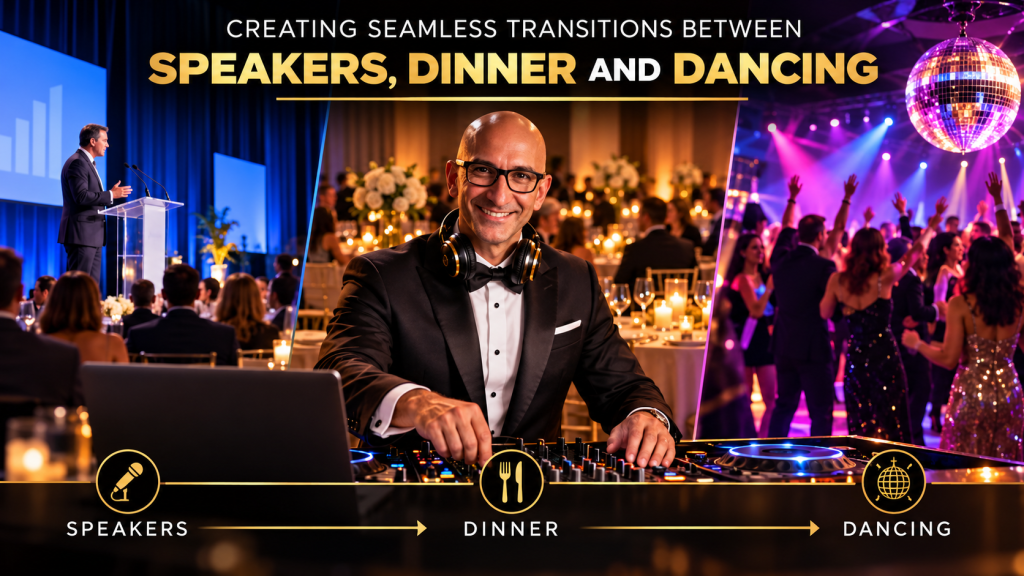
Suggested Image Alt Text: DJ Crash managing music and entertainment during an elegant corporate event, transitioning from dinner and speeches into dancing.
Blog Category: Corporate Event Planning & Production
Suggested Tags: Corporate Events, Event Flow, Music Direction, Corporate DJ, Event Production, Event Planning, Dinner Music, Event Entertainment, DJ Crash, Crash Entertainment.
Planning a Corporate Event?
From sophisticated cocktail receptions and executive dinners to awards ceremonies and high-energy celebrations, Crash Entertainment provides professional DJ services, music direction, sound, lighting, and event production backed by more than 30 years of experience.
Whether you’re planning a corporate gala, convention reception, company celebration, or private event, the right entertainment should make every part of the evening feel connected.
DJ Crash | Crash Entertainment
Phone: 323-963-3163
Email: djcrashusa@gmail.com
Website: www.djcrashusa.com
Instagram: @djcrashusa


