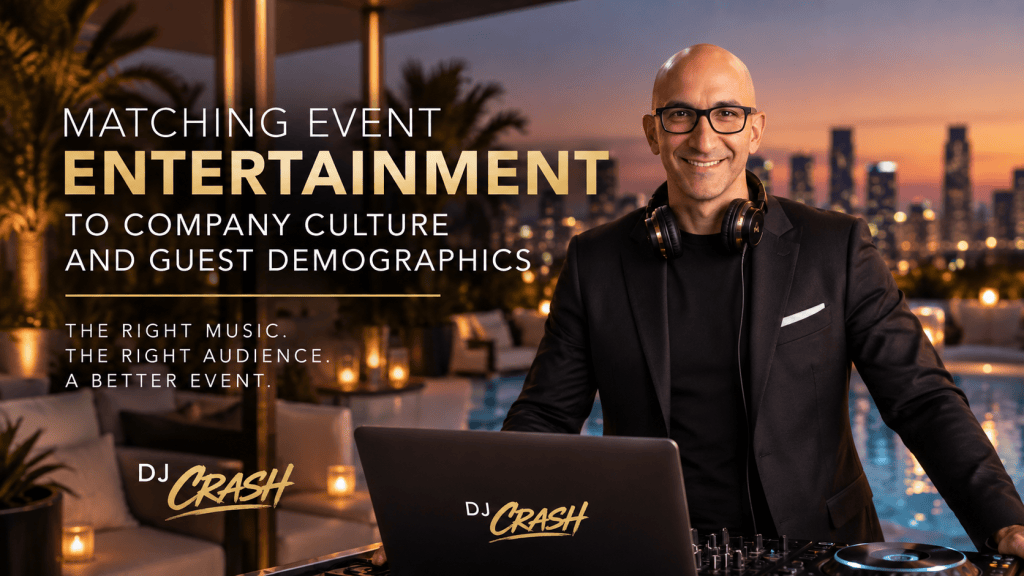
One of the biggest mistakes I see in corporate entertainment is starting with the wrong question.
“What kind of entertainment should we book?”
That sounds logical, but I think there’s a better question:
Who are we entertaining?
After more than 30 years of DJing corporate events, private parties, hotels, rooftops, nightclubs, weddings, galas, and large-scale events, I’ve learned that entertainment rarely succeeds simply because the DJ, band, performer, or concept is good. It succeeds because it is right for the people standing in the room.
I’ve worked events where guests wanted to dance almost immediately. I’ve worked others where people wanted to network for two hours before the party really started. Some corporate audiences respond to current music. Others come alive when they hear the songs they grew up with. Some groups want an energetic nightclub environment. Others want sophisticated background music that creates atmosphere without interfering with conversation.
None of those approaches is inherently better than another.
The job is figuring out which one belongs at this event, for this company, with these people, on this particular night.
That is where music direction and entertainment programming become much more important than simply creating a playlist.
Company Culture Should Influence the Entertainment
Every company has a personality, even if nobody has formally defined it.
A young technology company may have a very different culture from a financial-services company that has been around for 80 years. A fashion brand may approach entertainment differently from a pharmaceutical company. A creative agency, automotive manufacturer, law firm, hospitality company, startup, nonprofit organization, and international association can all have dramatically different expectations.
The entertainment should understand that culture rather than fight against it.
That doesn’t mean relying on stereotypes. Not every technology company wants electronic music, and not every law firm wants jazz during cocktails. I’ve seen supposedly conservative corporate groups turn into incredible dance floors, and I’ve seen companies that appeared extremely youthful and energetic on paper prefer a much more relaxed event in person.
You have to look deeper.
What does the company want this particular event to accomplish? Is it a celebration? A reward? A product launch? A networking reception? A holiday party? A convention after-party? An awards dinner? A client appreciation event?
The purpose of the event tells me far more than the company’s industry alone.
Demographics Matter, but They Aren’t the Whole Story
Age is one of the first things people consider when discussing entertainment demographics, and it certainly matters. A room dominated by guests in their 20s may react differently from one dominated by guests in their 50s.
But age is only one piece of information.
Where are the guests from? Is this a local event or an international conference? Are employees attending with spouses or partners? Are clients mixed with employees? Is senior management attending? Are guests primarily salespeople, engineers, executives, creatives, hospitality professionals, or a combination of all of them?
Even the relationship between the guests matters.
Five hundred strangers attending an industry conference behave differently from 500 employees who have worked together for years.
That changes the music.
It changes the pacing.
It can even change how much microphone work is appropriate.
The more I understand about the audience before an event, the better prepared I am. But preparation only gets me part of the way there. Once the event begins, I still have to watch what people actually do.
Never Confuse Demographics With a Playlist
This is an important distinction.
If somebody tells me the average guest is 45 years old, I don’t immediately create a playlist based on what 45-year-olds are theoretically supposed to like.
People aren’t algorithms.
Two people born in the same year can have completely different musical histories. One may have grown up listening to hip-hop. Another loves rock. Another grew up on dance music. Another prefers country, Latin music, R&B, alternative, disco, or pop.
That’s why I use demographics as information rather than instructions.
They help me prepare.
They don’t make the final decisions.
The audience does that.
A Corporate Event Is Usually Several Audiences at Once
This is one of the reasons open-format DJing has been so important throughout my career.
Corporate events frequently bring together people who would never normally attend the same nightclub.
You might have a 26-year-old marketing coordinator standing next to a 58-year-old executive. Employees may have traveled from New York, Los Angeles, Miami, London, Chicago, Mexico City, or Tokyo. Clients may be attending alongside staff members. Some people want current hits while others are waiting for a record they haven’t heard in 20 years.
The challenge isn’t finding one genre everybody likes.
That genre probably doesn’t exist.
The challenge is finding moments everybody can share.
That’s a very different approach to programming.
Instead of asking whether the room is an “’80s crowd” or a “current music crowd,” I look for records that create recognition across groups. Then I can move outward from those common points and explore different directions.
That is how a diverse room gradually becomes one audience.
Recognition Is One of the Most Powerful Tools at a Corporate Event
I love discovering new music, but a corporate dance floor usually isn’t where I try to prove how obscure my musical knowledge is.
Recognition matters.
When people hear the opening seconds of a song and immediately know what’s coming, something happens in the room. People smile. They turn toward friends. They start singing. Sometimes they head toward the dance floor before the beat even arrives.
That recognition creates confidence.
But recognition doesn’t mean playing the same obvious songs at every event.
The art is understanding which songs this particular audience recognizes and wants to hear tonight.
That’s where experience becomes valuable.
After decades of watching audiences respond to music, you begin to recognize patterns. But you also learn never to trust those patterns completely.
The room always gets the final vote.
The CEO Isn’t Necessarily the Target Audience
Corporate events create an interesting challenge because the person approving the entertainment isn’t always the person being entertained.
An executive may personally love one style of music, but the event could be for hundreds of employees with completely different tastes. An event planner might love house music, but the client’s audience may respond better to funk, hip-hop, rock, disco, or pop.
That’s why I think entertainment professionals have to be diplomatic.
The client absolutely deserves to have their preferences respected. They’re hiring us.
But part of being a professional is also being willing to offer constructive guidance.
If a client gives me an idea that I believe could create a problem, I don’t think my job is simply to say, “Yes.”
My job is to explain what I see, offer alternatives, and ultimately help them create the experience they’re trying to achieve.
That’s one of the differences between hiring someone to play music and hiring someone to help direct the event.
Music Should Change as the Event Changes
A corporate event shouldn’t necessarily sound the same at 6:00 p.m. as it does at 10:30 p.m.
That sounds obvious, but it’s something I think is frequently overlooked.
During arrival, the music may need to create atmosphere while guests register, order drinks, and begin conversations. During networking, the energy can rise without making communication difficult. Dinner may require another adjustment. Awards or speeches create another environment entirely.
Then the formal program ends.
Now the event may need to transform.
That transition is critical.
You don’t necessarily go from dinner music directly into the biggest dance record of the night. The room may need a bridge. People need permission to change behavior.
The lighting changes.
The volume changes.
The music changes.
Maybe the bar becomes busier.
People start moving away from tables.
Those details collectively tell guests that the event has entered another phase.
A good DJ doesn’t just notice that transformation.
We can help create it.
Volume Is Part of Understanding the Audience
Entertainment programming isn’t only about song selection.
Volume is one of the most underrated parts of the job.
I’ve been in plenty of events where the music was technically appropriate but simply too loud for what was happening. If guests are networking and have to shout into each other’s ears, the entertainment is working against the event.
There are also moments when music is too quiet.
If the party has reached its peak and the sound lacks impact, the room can feel flat even if the song selection is perfect.
Volume is another form of energy control.
The correct level changes throughout the night, and it should respond to the purpose of the room.
Professional sound isn’t about being loud.
It’s about being appropriate.
International Audiences Require an Even Wider Musical Vocabulary
Corporate events increasingly bring together guests from different countries and cultures.
That makes music programming incredibly interesting.
American chart success doesn’t automatically translate into global recognition. At the same time, certain records have become universal through decades of radio, movies, television, clubs, streaming, sporting events, and popular culture.
International events reward musical curiosity.
The more genres, eras, and cultures a DJ understands, the more pathways we have available when the audience moves in an unexpected direction.
That doesn’t mean randomly jumping between countries or genres to demonstrate versatility.
It means having options.
If one direction doesn’t connect, I can try another.
And when something suddenly works, I know enough music to stay there for a while and develop it.
Don’t Force the Dance Floor
Not every corporate event needs a packed dance floor.
I think that’s important for planners and entertainers to understand.
Sometimes success is 300 people dancing.
Sometimes success is 300 people having conversations while the DJ creates an incredible atmosphere around them.
Sometimes half the room is dancing while the other half is networking, drinking, or enjoying the environment.
The entertainment should support the purpose of the event rather than chase a photograph of a full dance floor.
I’ve always believed you can feel when an event is working.
People stay.
They interact.
They smile.
The room feels alive.
A dance floor is one measurement of engagement, but it isn’t the only one.
The Entertainment Should Reflect the Brand Without Becoming an Advertisement
Corporate entertainment can also reinforce the personality of a brand.
A luxury company might want an elegant, sophisticated musical environment. A lifestyle brand may want something more adventurous. A technology company may want a modern edge. A company celebrating a major anniversary might incorporate music from its history.
Those ideas can work beautifully when they’re subtle.
What I don’t want is for the entertainment to feel like a four-hour commercial.
Guests already know which company invited them.
The best brand integration often happens through the experience itself.
If the event feels sophisticated, exciting, thoughtful, generous, or innovative, guests associate those feelings with the company hosting it.
That’s much more powerful than putting a logo on everything.
Ask Better Questions Before Hiring Entertainment
If you’re planning a corporate event, I think the entertainment conversation should go much deeper than asking what genres the DJ plays.
Ask how they approach a mixed-age audience.
Ask what happens if the original music plan isn’t working.
Ask how they handle requests.
Ask how they transition from networking into dancing.
Ask how they manage volume during cocktails and dinner.
Ask whether they’re comfortable with executives, VIPs, international guests, and brand-sensitive environments.
Ask how they determine when to change direction.
Those answers tell you much more than a sample playlist ever will.
A playlist shows what someone might play.
Their answers tell you how they think.
Experience Gives You More Options
One of the greatest advantages of doing this for more than three decades is not that I know exactly what every audience wants.
Nobody does.
The advantage is that I’ve encountered an enormous number of situations.
I’ve seen dance floors explode when I expected them to build slowly. I’ve seen supposedly guaranteed songs fail. I’ve seen unusual requests transform an entire night. I’ve watched older crowds respond to new music and younger audiences lose their minds over records made decades before they were born.
Those experiences create options.
If Plan A isn’t working, I don’t panic.
I move to Plan B.
Then C.
Sometimes the audience shows me a Plan D I hadn’t even considered.
That’s the real value of experience in entertainment. It isn’t knowing exactly what’s going to happen.
It’s knowing what to do when what you expected doesn’t happen.
Final Thoughts: Entertainment Should Fit the People, Not the Spreadsheet
Corporate events are often planned months in advance. There are budgets, timelines, floor plans, run-of-show documents, production meetings, catering decisions, branding requirements, and countless spreadsheets.
All of those things matter.
But eventually the doors open and actual human beings walk into the room.
That’s when the plan meets reality.
The entertainment has to respond to those people rather than blindly follow assumptions made months earlier.
Company culture matters.
Demographics matter.
Client preferences matter.
The purpose of the event matters.
But once the event begins, the audience gives you information that no planning document can provide.
After more than 30 years of doing this, my approach is still surprisingly simple:
Prepare extensively.
Understand the client.
Know the audience.
Bring more music than you could possibly need.
Then pay attention.
Because the best corporate entertainment isn’t entertainment that was theoretically perfect on paper.
It’s entertainment that feels like it was made specifically for the people who were actually in the room.
— DJ Crash
30+ Years of Professional DJ & Event Experience
Corporate Events • Hotels • Rooftops • Conventions • Galas • Private Events • Weddings • Large-Scale Entertainment


