Most people think the DJ’s most important job begins when the dance floor opens.
I disagree.
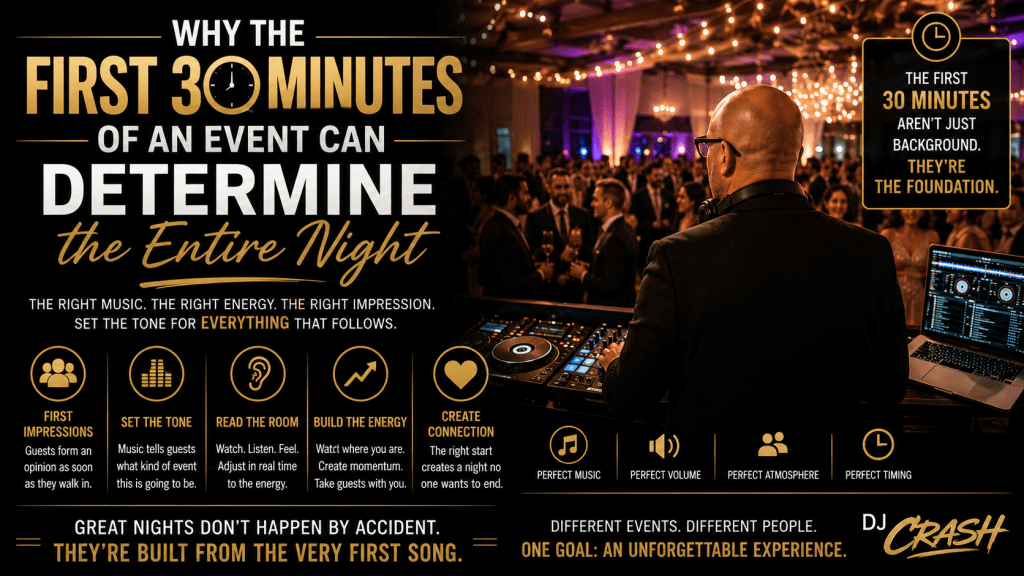
After more than 30 years of DJing weddings, corporate events, hotels, private parties, mitzvahs, nightclubs, galas, and large-scale events, I’ve learned that some of the most important decisions I make happen during the first 30 minutes.
Long before anyone is dancing.
Before the big songs.
Before the room reaches its peak.
Because when guests first walk through the door, something important is already happening:
The event is teaching them how it’s supposed to feel.
The music is a major part of that message.
Guests Form an Opinion Almost Immediately
Think about the last great event you attended.
You probably felt something almost as soon as you arrived.
Maybe the room felt sophisticated.
Maybe it felt exciting.
Maybe it felt intimate.
Maybe it immediately felt like a party.
That reaction doesn’t happen because someone announces, “Welcome to our sophisticated and exciting event.”
It happens through hundreds of details working together.
Lighting.
Décor.
Staff.
Food and beverage.
The venue.
The crowd.
And music.
The DJ is helping establish the emotional temperature of the room from the moment the first guests arrive.
That’s why I never consider arrival music an afterthought.
It’s the beginning of the story.
Don’t Start at 100
One of the easiest mistakes a DJ can make is trying to create maximum energy immediately.
I understand the temptation.
Guests arrive.
The DJ wants to impress them.
So the volume goes up, the biggest records start playing, and suddenly the room sounds like it’s midnight even though people are still checking their coats.
Where do you go from there?
Great events need somewhere to go.
If you begin at 100, you can’t build to 100.
You’re already there.
I’ve always believed energy should be earned throughout the night.
Start at the appropriate level.
Establish the atmosphere.
Watch the room.
Then gradually begin turning the dial.
Not just the volume dial.
The energy dial.
The First Songs Tell Guests What Kind of Event They’re Attending
Music communicates extraordinarily quickly.
Play one type of music and a room feels luxurious.
Change the selection and suddenly it feels playful.
Change it again and it becomes nostalgic.
Another change can make it feel sexy, cool, elegant, rebellious, youthful, sophisticated, international, or celebratory.
That’s incredibly powerful.
And it means the opening music deserves thought.
At a luxury hotel reception, I might want the music to feel polished and cosmopolitan.
At a corporate event, the goal might be energetic and contemporary without interfering with networking.
At a private party, I might begin introducing music connected to the host’s personality immediately.
At a wedding, I might be thinking about multiple generations and creating an environment where everyone feels included.
The songs don’t need to scream for attention.
They need to establish identity.
I’m Already Reading the Room
People often associate “reading the room” with a packed dance floor.
That’s only part of it.
I’m reading the room before the dance floor even exists.
I’m watching how guests enter.
Are they immediately social?
Are they reserved?
Are they heading toward the bar?
Are people standing or sitting?
Is the room filling quickly?
What are the age demographics?
Are guests reacting to particular songs?
Are people subtly moving to the music while talking?
Sometimes I’ll see someone across the room recognize a song and smile.
That’s information.
Someone starts tapping a foot.
Information.
A group sings one line of a chorus while they’re having a conversation.
More information.
Those little reactions begin telling me where the evening might go.
Cocktail Music Isn’t Background Noise
The term “background music” can sometimes make people think the music doesn’t matter.
I think the opposite is true.
Music doesn’t have to dominate a room to influence it.
The right cocktail music can make a space feel alive without making conversation difficult.
It can encourage guests to relax.
It can establish sophistication.
It can subtly create anticipation.
The goal isn’t necessarily to make people consciously think:
“This is a fantastic song.”
Sometimes the better reaction is:
“This party feels great.”
They may not even realize why.
That’s music direction.
Corporate Events Make the Opening Especially Important
Corporate events are a perfect example.
Guests might be coworkers who see each other every day.
They might be clients meeting for the first time.
They might have just spent eight hours at a convention.
They may be executives entertaining important customers.
They could be employees celebrating a successful year.
Those situations require completely different musical approaches.
A DJ who simply arrives with a generic “corporate playlist” is missing the point.
What’s the purpose of the event?
Networking?
Celebration?
Hospitality?
Brand activation?
Awards?
Client entertainment?
The opening music should support that objective.
If guests need to network, I don’t want to make them compete with the sound system.
If the company wants an energetic celebration, I might begin planting musical clues early that tell guests:
We’re going somewhere tonight.
Volume Is Part of the First Impression
I’ve written before about volume because I think it’s one of the most misunderstood elements of event entertainment.
The first 30 minutes are especially important.
People are greeting each other.
They’re catching up.
They’re making introductions.
They’re ordering drinks.
They shouldn’t have to shout.
I would rather begin slightly too low and gradually bring the room upward than begin too loud and immediately make guests uncomfortable.
Great sound should feel good.
It shouldn’t announce the existence of the speakers.
Don’t Waste Your Biggest Records
Another common mistake is playing too many massive songs too early.
DJs sometimes feel pressure to prove how great their music selection is.
But a great song is only great in the right context.
If I know a particular record has the potential to create a huge moment later, why would I casually burn it while half the guests are still arriving?
Timing changes music.
A song at 7:15 p.m. isn’t necessarily the same song at 10:45 p.m.
The recording is identical.
The moment isn’t.
That’s one of the fundamental differences between selecting music and DJing.
Give the Room Somewhere to Go
I think of an event almost like a movie.
You wouldn’t want the biggest scene in the first five minutes followed by three hours of diminishing excitement.
You establish the world.
Introduce the characters.
Build momentum.
Create anticipation.
Then deliver the moments people remember.
Events work the same way.
Arrival.
Cocktails.
Dinner.
Transition.
Dancing.
Peak.
Finale.
Not every event follows that exact structure, but nearly every successful event has an emotional arc.
The DJ helps shape that arc.
The DJ Should Be Working Before Anyone Notices
Some of the most important work I do at an event is invisible.
I’m checking sound throughout the room.
I’m watching guests.
I’m communicating with planners and event staff.
I’m paying attention to timing.
I’m adjusting the musical direction.
I’m identifying which demographics are responding.
I’m learning the personality of the crowd.
Guests shouldn’t notice any of that.
They should simply feel like everything is working.
Professionalism often looks effortless because the work is happening quietly.
The Room Will Tell You What It Wants
Sometimes I arrive with an idea about how the night might develop.
Then the guests arrive and tell me something completely different.
That’s okay.
Actually, that’s one of my favorite parts of DJing.
The plan gives me direction.
The audience gives me reality.
If the room is more energetic than expected, I’ll respond.
If people need more time to socialize, I’ll give it to them.
If an unexpected style of music starts connecting with several groups, I’ll remember it.
The event isn’t happening inside my laptop.
It’s happening in front of me.
This Is Why I Don’t Believe in Completely Preprogrammed Events
Preparation is essential.
Preprogramming every moment is something else entirely.
I want to know the important songs.
I want to understand the client.
I want to understand the schedule.
I want to understand the venue and the audience.
But once the doors open, I want the flexibility to react.
That’s the difference between simply executing a playlist and actually DJing.
A predetermined set can only tell you what you thought the audience would want.
Reading the room tells you what they’re telling you right now.
The First 30 Minutes Create Trust
There’s another part of this that people rarely discuss.
Guests are subconsciously deciding whether they trust the event.
Does everything feel organized?
Does the environment feel comfortable?
Does the music fit?
Is the volume right?
Does the room feel alive?
When those elements work together, people relax.
And relaxed guests become engaged guests.
Engaged guests become participants.
Participants become a party.
That’s why the first half hour matters so much.
You’re not trying to create the climax.
You’re creating permission for everything that comes afterward.
Great Events Build
Some nights explode quickly.
Others take time.
Neither is necessarily better.
The important thing is understanding the room you’re actually working with.
After thousands of events, I’ve learned not to force the timeline simply because I have an idea of how a party is “supposed” to work.
Every audience has its own rhythm.
My job is to find it.
Then build from there.
Final Thoughts: The Party Starts Before the Dancing
If you’re planning a wedding, corporate event, hotel reception, mitzvah, gala, private party, fundraiser, or any other special event, don’t think of the DJ as someone who becomes important only when dancing begins.
The experience starts when the first guest arrives.
The first song matters.
The volume matters.
The atmosphere matters.
The pacing matters.
And most importantly, paying attention matters.
After more than three decades behind the decks, I’ve learned that you don’t create an unforgettable night by immediately giving people everything you’ve got.
You create it by giving them the right thing at the right moment.
The first 30 minutes aren’t about showing guests how big the party can become.
They’re about quietly making them want to stay long enough to find out.
— DJ Crash
30+ Years of Professional DJ & Event Experience
Weddings • Corporate Events • Hotels • Mitzvahs • Private Parties • Nightclubs • Luxury Events


