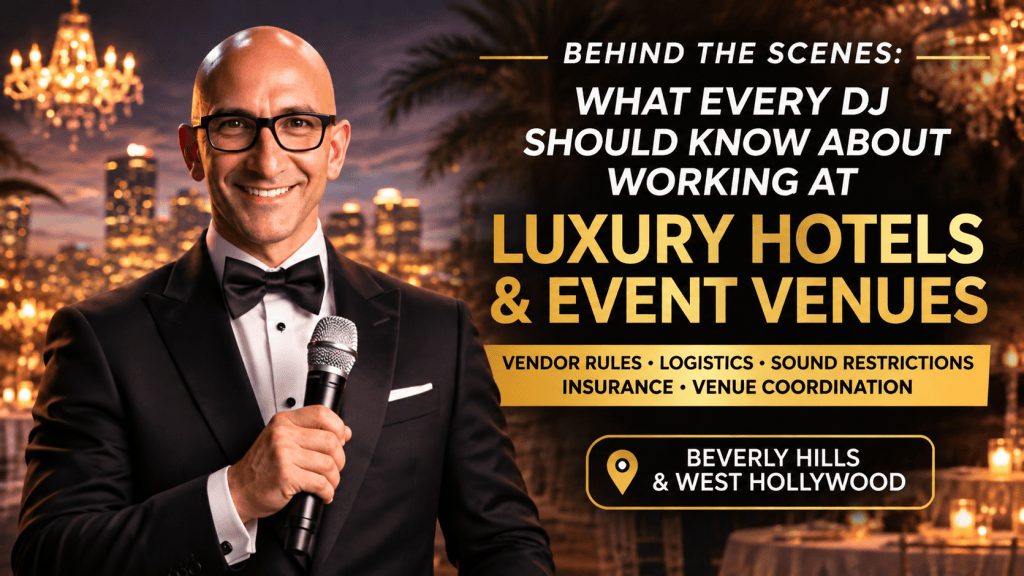
By DJ Crash | Founder, Crash Entertainment
After more than 30 years working as a professional DJ and music director, I’ve learned that some of the most important work happens long before the first song plays.
When guests attend an elegant wedding, corporate reception, awards gala, or private celebration, they see the finished experience. The lighting looks beautiful, the music sounds great, and the evening appears effortless.
What they don’t see is everything required to make that happen.
Loading equipment through service entrances. Coordinating with hotel security. Confirming insurance requirements. Understanding sound restrictions. Working around catering schedules. Communicating with banquet managers. Making sure the equipment is set up, tested, and ready before guests arrive.
These details might not be particularly glamorous, but they’re essential.
And when you’re working at luxury hotels and high-end event venues in Beverly Hills, West Hollywood, or anywhere else, understanding the property’s rules is just as important as knowing how to entertain the audience.
A professional DJ doesn’t simply arrive prepared to play music. They arrive prepared to work within the venue’s operation.
Every Venue Has Its Own Personality
One of the biggest mistakes an entertainer can make is assuming that every venue operates the same way.
A luxury hotel ballroom has different requirements from a rooftop restaurant. A historic mansion presents different challenges from a modern convention center. A private residence may offer greater flexibility in some areas while creating entirely different logistical concerns.
During my career, I’ve worked in a wide variety of environments, including luxury hotels, nightclubs, restaurants, rooftops, private estates, and major corporate events.
My years as Music Director at Barfly West Hollywood, an upscale supper club owned by the Buddha Bar family, taught me a great deal about the relationship between music, hospitality, and venue operations.
I performed four nights a week for seven years, helping create the musical atmosphere as the room transitioned from sophisticated dining and cocktails into late-night entertainment.
That experience reinforced something I’ve always believed:
The entertainment should complement the venue, not compete with it.
Every property has an identity, an operating structure, and expectations about how events should be managed.
Understanding those expectations is part of being a professional.
Load-In and Setup Are More Important Than You Think
One of the first things I want to understand before arriving at a venue is how equipment gets into the building.
That might sound simple, but it can become surprisingly complicated.
Some hotels require vendors to use designated loading docks and freight elevators. Others have specific delivery windows or restrictions on where vehicles can park.
A rooftop venue may require equipment to travel through several service corridors and elevators before reaching the performance area.
Historic properties can present narrow doorways, stairs, limited electrical access, or restrictions designed to protect the building.
I’ve learned never to assume that the entrance guests use is the entrance vendors can use.
Before an event, I want to know where to park, where to unload, how far the equipment must travel, and whether there are any restrictions on setup times.
Those details determine how much time and assistance may be required.
A DJ setup that takes an hour in an easily accessible ballroom could require considerably longer at a property with complicated access.
That’s why proper planning matters.
Understand the Venue’s Insurance Requirements
Many luxury hotels, corporate venues, and event properties require outside vendors to carry liability insurance.
Some may request a certificate of insurance identifying the property or management company as an additional insured.
Requirements vary, so it’s important to confirm them directly with the venue.
I carry professional liability insurance because it’s part of operating an entertainment business responsibly.
But having insurance isn’t the end of the conversation.
The venue may have specific coverage requirements, documentation deadlines, or procedures for submitting certificates.
I recommend addressing those details early rather than discovering a problem a day or two before the event.
The objective is simple: make sure the paperwork is handled before it becomes an obstacle.
Sound Restrictions Can Change the Entire Production
One of the most important considerations when working at luxury properties is sound management.
This is particularly relevant at rooftop venues, hotels with guest rooms, outdoor terraces, and properties surrounded by residential neighborhoods.
A venue may have restrictions on amplified music, operating hours, speaker placement, or maximum sound levels.
Those restrictions can influence the entire entertainment plan.
For example, an outdoor cocktail reception may require a smaller sound system than an indoor ballroom.
A rooftop event may need carefully positioned speakers to minimize sound traveling beyond the property.
A hotel may require the entertainment to conclude at a specific time.
I’ve always believed that good sound doesn’t necessarily mean loud sound.
The objective is appropriate coverage, clarity, and an enjoyable experience.
Guests should hear the music comfortably without unnecessary volume.
And the production should respect the venue’s operating requirements.
The best sound system isn’t always the biggest one. It’s the one that works properly for the room.
Don’t Assume the Venue Provides Everything
Another important lesson is understanding exactly what equipment the venue includes.
Some properties have built-in sound systems, microphones, lighting, or audiovisual infrastructure.
Others provide little more than electrical outlets and a designated performance area.
Even when equipment is available, it may not be suitable for the event.
A hotel’s background music system might work beautifully for a cocktail reception but lack the flexibility or low-frequency response needed for dancing.
A venue may have wireless microphones, but those microphones might be reserved for its in-house audiovisual provider.
Lighting may be available, but the controls or permitted settings could be limited.
Before the event, I want to establish what’s included, what’s available for outside vendors, and what I need to provide.
That prevents misunderstandings and unnecessary last-minute expenses.
Build Relationships With the Venue Staff
One of the most valuable lessons I’ve learned throughout my career is that successful events depend on relationships.
The banquet captain, catering manager, audiovisual technician, security staff, and event coordinator all play important roles.
They’re not obstacles to work around.
They’re part of the team.
When I arrive at a venue, I want to understand who is responsible for the event and how communication will work.
If dinner is running late, someone needs to tell me.
If a speech is about to begin, I need to know.
If the room needs to be cleared before equipment can be removed, I need to respect that schedule.
Good communication helps everyone do their jobs.
I’ve always tried to maintain a calm, cooperative approach because I understand how much pressure event teams can experience.
A professional entertainer should make their jobs easier, not more complicated.
Luxury Hospitality Requires a Different Mindset
Working in luxury hospitality taught me that the guest experience extends far beyond the music.
At properties such as W Hollywood and Spire73 at the InterContinental Los Angeles Downtown, the atmosphere is part of the venue’s identity.
The music needs to fit the environment.
The equipment should be presented professionally.
The DJ’s appearance should be appropriate.
Volume levels should support the experience.
And the entertainment should evolve naturally throughout the evening.
This is particularly important when a venue transitions from dining and cocktails into a more energetic social atmosphere.
You can’t approach every moment as though you’re performing in a nightclub at midnight.
Sometimes the music needs to be sophisticated and understated.
Sometimes it needs to create anticipation.
And sometimes it’s time to bring the energy up.
Knowing the difference is a major part of professional music direction.
Respect the Venue’s Schedule
Luxury venues often operate on tightly managed schedules.
There may be another event taking place before yours.
The catering team may need time to reset the room.
Housekeeping or banquet staff may have specific responsibilities.
The venue may require all equipment to be removed by a certain time.
These schedules affect entertainment production.
For example, if a ballroom becomes available for setup only two hours before guests arrive, the DJ needs to know whether that provides enough time.
My typical setup takes approximately two hours, depending on the equipment and venue requirements.
More complicated productions involving additional sound systems, lighting, or difficult access may require additional time.
The important thing is identifying those requirements before the event.
Arriving early doesn’t necessarily help if the venue hasn’t authorized access to the room.
Professional preparation means coordinating with the property’s schedule rather than assuming the space will be available whenever you want it.
Appearance and Presentation Matter
Luxury hospitality is an environment where details matter.
That includes how entertainment professionals present themselves.
I’ve always believed that a DJ should dress appropriately for the occasion.
A black-tie gala may call for formal attire.
An upscale rooftop reception might be better suited to a stylish jacket and contemporary smart-casual look.
A corporate awards dinner may require something more conservative.
The same principle applies to equipment.
A clean DJ booth, organized cables, properly positioned speakers, and thoughtfully arranged lighting can make a significant difference.
Guests shouldn’t have to navigate equipment cases, exposed wiring, or cluttered production areas.
A professional setup should look like it belongs in the room.
Don’t Let Production Overpower the Venue
One mistake I occasionally see is bringing more equipment than the event actually needs.
A relatively intimate corporate reception doesn’t necessarily require enormous speakers, extensive lighting, or complicated production effects.
In fact, too much equipment can undermine the atmosphere.
I’ve always preferred designing the production around the venue and audience.
If a property already has beautiful architectural lighting, I may only need a few additional fixtures.
If the event is primarily a cocktail reception, a modest sound system may provide everything required.
If dancing is a major part of the evening, additional sound and lighting may be appropriate.
The objective isn’t to demonstrate how much equipment I own.
It’s to create the best possible experience.
Good production should enhance the venue’s character, not overwhelm it.
Prepare for Unexpected Changes
Even carefully planned events encounter surprises.
An elevator becomes unavailable.
A loading dock is temporarily occupied.
The room isn’t ready when expected.
A power outlet doesn’t work.
The event schedule changes.
A client requests an additional microphone or announcement.
These situations are part of live event production.
Experience teaches you to remain flexible and focus on solutions.
Sometimes that means adjusting the equipment layout.
Sometimes it means working with venue staff to find an alternative setup.
Sometimes it means simplifying the production to meet the available schedule.
The important thing is not allowing a manageable problem to become unnecessary drama.
After more than three decades in this business, I’ve learned that maintaining a calm, professional attitude is one of the most valuable things an entertainer can bring to an event.
Why Venue Experience Matters When Hiring a DJ
For clients planning events at luxury hotels, historic properties, private estates, or upscale hospitality venues, I recommend asking prospective DJs about their experience working in similar environments.
Do they understand insurance requirements?
Are they comfortable coordinating with venue management?
Can they adapt their sound system to different room sizes?
Do they know how to manage setup and breakdown schedules?
Can they work with an in-house audiovisual team?
Are they familiar with the expectations of luxury hospitality?
These questions are just as important as asking about musical preferences.
A DJ might be excellent at mixing music but inexperienced in managing the logistics of a complicated venue.
That doesn’t necessarily make them a bad entertainer.
But it may mean they need additional guidance or support.
An experienced professional should already understand how these environments operate.
The Best Events Look Effortless Because Someone Did the Work
When everything goes correctly, guests rarely notice the logistics.
They don’t think about the freight elevator.
They don’t know how many conversations took place with the banquet manager.
They don’t see the insurance paperwork.
They don’t know whether the sound system required adjustments.
They simply arrive at a beautiful venue, enjoy the music, and have a wonderful evening.
That’s exactly how it should be.
The preparation should remain behind the scenes.
The experience should feel effortless.
Final Thoughts: Professionalism Begins Before the First Song
After more than 30 years working in entertainment, I’ve learned that being a successful DJ involves much more than musical knowledge.
It’s about preparation, communication, flexibility, and understanding the environment you’re working in.
Luxury hotels and high-end event venues have established operating procedures for good reasons.
Those procedures help protect the property, support the staff, and create a consistent guest experience.
A professional entertainer should understand and respect them.
Whether I’m performing at a Beverly Hills hotel, a West Hollywood rooftop, a corporate convention, or a private estate, my objective remains the same.
Arrive prepared.
Work cooperatively with the venue.
Provide appropriate sound and lighting.
Understand the audience.
And create an experience that feels natural from beginning to end.
The best DJs don’t simply know how to play the right music. They know how to work with the people, spaces, and circumstances that make a great event possible.
That’s what professionalism looks like behind the scenes.
— DJ Crash
Founder, Crash Entertainment
30+ Years of Professional DJ & Event Experience
Corporate Events • Luxury Hotels • Rooftops • Conventions • Galas • Weddings • Private Events • Music Direction & Event Production


