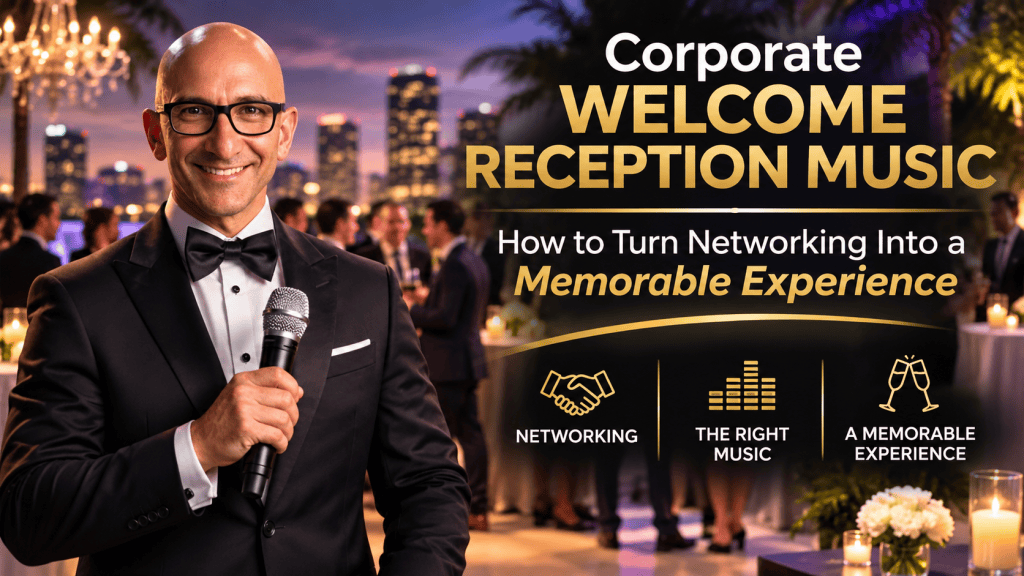
By DJ Crash | Founder, Crash Entertainment
After more than 30 years working as a professional DJ, music director, and event producer, I’ve learned that some of the most important entertainment opportunities at corporate events happen before anyone steps onto a dance floor. They happen during the welcome reception. Whether it’s a major industry convention, a corporate leadership summit, an executive gathering, or a multi-day conference, the opening reception often establishes the atmosphere for everything that follows. It’s where colleagues reconnect, new business relationships begin, sponsors meet prospective clients, and attendees get their first real impression of the event.
Yet music is frequently treated as an afterthought. Someone puts together a playlist, turns on the venue’s background sound system, and assumes the atmosphere will take care of itself. Sometimes that works, but in my experience, a thoughtfully programmed welcome reception can transform an ordinary networking function into one of the most enjoyable and memorable experiences of an entire conference. The difference isn’t necessarily the budget or the size of the production. It’s understanding how music, hospitality, sound, timing, and audience energy work together.
The Welcome Reception Is More Than a Cocktail Party
When a company or convention organizer plans a welcome reception, the objective is usually much broader than providing drinks and appetizers. The event may be designed to encourage networking, introduce sponsors, welcome first-time attendees, reconnect industry colleagues, or create enthusiasm for the conference ahead. Music should support those objectives, and the best programming begins with understanding why people are attending.
For example, a reception for senior executives may benefit from sophisticated lounge music, modern soul, funk, or understated house. A technology conference might have a more contemporary musical personality, while a hospitality industry gathering could incorporate disco, soulful house, and recognizable crossover selections. An international convention may benefit from a wider musical approach that reflects the diversity of its audience. The key is recognizing that not every corporate reception should sound the same, and the music should reflect the personality of the event rather than simply the personal preferences of the DJ.
Why the First 30 Minutes Matter
One of the most important periods of any reception is the beginning. Guests are arriving, checking in, finding colleagues, and becoming familiar with the space. Some may have spent the entire day traveling, while others may be meeting clients or coworkers for the first time. This isn’t necessarily the moment to introduce aggressive dance music or nightclub-level volume. I prefer creating an atmosphere that feels welcoming, comfortable, and energetic without demanding everyone’s attention.
That might mean a combination of sophisticated funk, soul, disco-influenced grooves, and contemporary lounge selections. The music should establish a personality and make the room feel alive without making conversation difficult. Over the years, I’ve learned that the first musical impression can influence how guests perceive the entire evening. A room that feels comfortable and thoughtfully programmed encourages people to settle in, while a room that’s excessively loud or musically disconnected from the audience can have the opposite effect.
Music Direction Is Different From Playing a Playlist
A playlist is a collection of songs, while music direction is the process of deciding how those songs should support the experience as it develops. During my years as Music Director and resident DJ at Barfly West Hollywood, I worked four nights a week for seven years, helping shape the musical identity of a venue that evolved from dining and cocktails into late-night entertainment. That experience taught me how important musical progression can be. You don’t necessarily want the same energy at 7 PM that you want at 11 PM, because the atmosphere needs room to develop.
I’ve applied that philosophy throughout my career, including music direction roles at W Hollywood and Spire73 at the InterContinental Los Angeles Downtown. At a corporate welcome reception, the same principles apply, even when the event lasts only two hours. The music should respond to the audience, the venue, and the schedule. It should never feel like someone simply pressed play and walked away.
Reading the Room Is Still the Most Important Skill
Technology has made it easier than ever to access music. A DJ can carry an enormous library of songs on a laptop and move between genres almost instantly, but technology can’t replace the ability to understand an audience. I pay attention to how guests are interacting, whether they’re having quiet conversations, gathering near the bar, responding to recognizable songs, or beginning to move with the music. Those observations help determine what comes next.
Sometimes I increase the energy, sometimes I maintain the current musical direction, and sometimes I bring the volume down because a large group has gathered for conversation. The important thing is staying connected to what’s happening in the room. A great reception DJ isn’t just playing music for the audience. They’re responding to the audience, often making small adjustments that guests may never consciously notice but that significantly improve the atmosphere.
The Volume Should Support Networking, Not Fight It
This is one of my strongest opinions about corporate entertainment. Louder doesn’t automatically mean better. At a welcome reception, guests are often there specifically to meet people and have conversations. If they have to shout over the music, something is wrong. I’ve worked in luxury hotels, restaurants, rooftops, private events, and large-scale corporate environments where sound management is an essential part of the experience.
The objective is to create consistent, clear coverage without overwhelming the space. Sometimes that requires multiple smaller speakers positioned strategically rather than one excessively loud system. Sometimes it means adjusting speaker placement so the music reaches the room without dominating conversation areas. And sometimes it means recognizing that a relatively simple sound system is all the event needs. Professional audio is about control, clarity, and coverage, not just volume.
I also believe a DJ should physically walk around the room during the event to understand what guests are hearing. Sound levels can vary dramatically depending on where someone is standing or sitting. What sounds comfortable behind the DJ booth may be overwhelming near a speaker or barely audible across the room. I make a point of listening from different positions because the experience should be balanced throughout the space. If a client needs to speak with me during the event, I prefer moving somewhere we can actually have a conversation rather than trying to communicate directly in front of a loudspeaker.
The Venue Should Influence the Music
A welcome reception at a luxury hotel rooftop has a different personality from one held inside a convention center. A poolside reception in Palm Springs might call for relaxed disco, funk, soulful house, and sunset-inspired music, while a sophisticated ballroom gathering could benefit from elegant lounge selections and familiar crossover records. A branded activation on a convention show floor may require a more contemporary, attention-grabbing musical approach.
The venue’s architecture, acoustics, lighting, and layout all influence how the music should be presented. I wouldn’t approach a rooftop overlooking Los Angeles the same way I’d approach an indoor convention reception with hundreds of attendees. The atmosphere should make sense for the location, which is one reason I believe music direction and event production should be considered together. When the music fits the venue, everything feels more natural.
Don’t Forget the Sponsors and Exhibitors
At major conventions, sponsors and exhibitors frequently invest significant resources in creating opportunities to meet prospective clients. Welcome receptions, networking events, hospitality suites, and private parties can become valuable extensions of that investment. Music can help make those spaces more inviting, encouraging guests to stay, socialize, and enjoy themselves while creating a more distinctive atmosphere than a generic hotel meeting room.
For a sponsor hosting a private gathering, the musical direction might reflect the company’s personality while remaining appropriate for its audience. A premium brand may want an elegant, understated approach, while a consumer-facing lifestyle brand may prefer a more energetic experience. The objective isn’t to turn every sponsor event into a nightclub. It’s to create an environment where the company and its guests can connect comfortably.
A Two-Hour Reception Still Needs a Musical Journey
Some planners assume that a short reception doesn’t require much musical preparation. I disagree. In fact, shorter events can require particularly thoughtful programming because there’s limited time to establish the right atmosphere. During the first 30 minutes, I might focus on sophisticated soul, lounge, relaxed funk, and warm background grooves while guests arrive and settle into the space. As the reception progresses, I can gradually introduce more recognizable crossover selections, tasteful disco, and soulful house, allowing the energy to build without interfering with conversation.
During the middle portion of the reception, I might move toward more upbeat selections if the audience is responding positively. As the event approaches its conclusion, the music can either maintain that energy or gradually transition toward a comfortable finish, depending on what happens next. If guests are moving to dinner or a presentation, the music should help guide that transition. If the reception is becoming a celebration, there may be an opportunity to continue building momentum.
The important thing is flexibility. If guests are enthusiastically responding to the music, I may keep the energy elevated. If everyone is engaged in serious networking conversations, I’ll adjust accordingly. The music should never become more important than the event’s purpose, and a rigid playlist or timeline shouldn’t prevent the DJ from responding to what’s actually happening.
The DJ Should Be Part of the Production Team
At corporate events, communication is essential. The event planner, catering team, venue manager, audiovisual crew, and entertainment provider all have responsibilities, and those responsibilities need to work together. If the reception includes executive remarks, sponsor acknowledgments, or announcements, those moments should be coordinated so the music doesn’t abruptly stop in the middle of a song because someone unexpectedly approaches a microphone.
A professional DJ should know when presentations are scheduled, who is responsible for cueing them, and how the evening is expected to progress. I also want to understand whether the venue has an in-house sound system, what microphones are available, and whether additional equipment is required. These details may seem minor, but they contribute significantly to a polished event. My objective is always to make the planner’s job easier while remaining flexible enough to accommodate changes.
Great Corporate Entertainment Doesn’t Have to Be Complicated
One of the misconceptions about corporate entertainment is that creating an impressive atmosphere requires elaborate production. Sometimes it does. Large conventions, awards ceremonies, and major brand activations may require extensive sound, lighting, staging, and technical support. But many welcome receptions can be extremely successful with a relatively simple setup consisting of a professional DJ, appropriate sound coverage, a clean presentation, and tasteful lighting when needed.
I’ve seen events where clients spent enormous amounts of money on equipment and production elements that contributed very little to the actual guest experience. Expensive speakers, elaborate lighting rigs, and oversized production packages don’t automatically create a better atmosphere. I’d rather see a client invest in experienced music direction and reliable sound than spend unnecessarily on equipment that doesn’t improve the event. The objective is to create atmosphere, not to fill the room with gear.
From Welcome Reception to Afterparty
One of the most interesting opportunities at multi-day conventions is connecting different entertainment experiences. A conference may begin with a welcome reception, continue with sponsor networking events, and conclude with an awards celebration or closing party. Each occasion has a different purpose, but the entertainment can still feel connected.
The opening reception establishes the atmosphere, a sponsor gathering may offer a more intimate experience, and the closing celebration can deliver a much higher-energy musical program. For event organizers, working with an experienced music director across multiple functions can create consistency while allowing each event to have its own identity. I’ve always enjoyed this kind of programming because it combines hospitality, entertainment, and event production. It’s not simply about filling a time slot with music. It’s about helping shape the overall guest experience.
What Event Planners Should Ask Before Booking a Reception DJ
Before hiring entertainment for a corporate welcome reception, I recommend discussing more than the hourly rate. The DJ should understand the purpose of the event, the audience, the venue, and the schedule. They should be comfortable providing music that supports conversation rather than constantly pushing for dancing, and they should know how to manage volume appropriately while coordinating with the venue’s production team.
It’s also important to clarify whether sound equipment, microphones, setup, travel, and other requirements are included. Ask about the DJ’s experience with corporate receptions, conventions, hospitality events, and different musical styles. A great nightclub DJ may be fantastic at building a dance floor but less experienced at creating an environment where people need to communicate comfortably. An experienced open-format DJ with a strong understanding of hospitality programming can often adapt more easily to these different environments.
Most importantly, pay attention to whether the DJ listens. The client’s objectives should guide the entertainment, and an experienced professional should be able to offer constructive suggestions without becoming inflexible or allowing ego to interfere with the event.
Why Experience Makes a Difference
Over the course of my career, I’ve had the opportunity to work in nightclubs, hotels, corporate environments, private estates, and large entertainment productions. I’ve also been involved in extensive retail and branded-event programming, including more than 1,600 Bloomingdale’s events and hundreds of Macy’s events. Those experiences have reinforced how differently music functions in different environments.
What works in a nightclub may not work during a corporate reception. What works at a rooftop sunset event may not work at an executive dinner, and what works for one convention audience may not connect with another. The common thread is understanding people. After more than 30 years, that’s still what I find most interesting about DJing. Every room is different, every audience has its own personality, and every event presents an opportunity to create something memorable.
Experience also teaches you that great entertainment isn’t about showing off technical skills or playing the most impressive records in your collection. It’s about understanding timing, musical progression, sound levels, and the subtle changes in energy that can make a room feel comfortable or exciting. Sometimes the best decision is to play something unexpected. Sometimes it’s to return to a familiar groove. And sometimes it’s simply knowing when to let the music remain in the background.
Final Thoughts: The Best Networking Events Have an Atmosphere People Remember
When guests leave a successful welcome reception, they may not remember every song that was played or the type of speakers and lighting equipment used. But they’ll remember how the event felt. They’ll remember whether the room was welcoming, whether they enjoyed the conversations, whether the atmosphere was energetic without being overwhelming, and whether the evening felt polished and professionally organized.
That’s what great music direction contributes. A corporate welcome reception doesn’t need to become a nightclub to be successful. It needs to create an environment where people feel comfortable connecting, celebrating, and enjoying the experience. The best corporate reception music doesn’t interrupt the networking. It makes the networking better, and when that happens, the entertainment becomes part of what makes the entire event memorable.
After three decades behind the decks, I continue to believe that the greatest value a professional DJ brings isn’t simply the ability to play music. It’s the experience to understand the room, anticipate its needs, and create an atmosphere that feels effortless to everyone attending.
— DJ Crash
Founder, Crash Entertainment
30+ Years of Professional DJ & Music Direction Experience
Corporate Events • Conventions • Luxury Hotels • Rooftops • Welcome Receptions • Sponsor Events • Private Celebrations
Planning a Corporate Welcome Reception?
Crash Entertainment provides professional DJ services, music direction, sound, and event entertainment for corporate conferences, executive gatherings, convention receptions, sponsor activations, and upscale hospitality events. From sophisticated background programming to energetic networking celebrations, the objective is always to create the right atmosphere for the audience and occasion.
DJ Crash | Crash Entertainment
Phone: 323-963-3163
Email: djcrashusa@gmail.com
Website: https://www.djcrashusa.com
Instagram: https://www.instagram.com/djcrashusa/
SoundCloud: https://soundcloud.com/djcrashusa
Linktree: https://linktr.ee/djcrashusa


