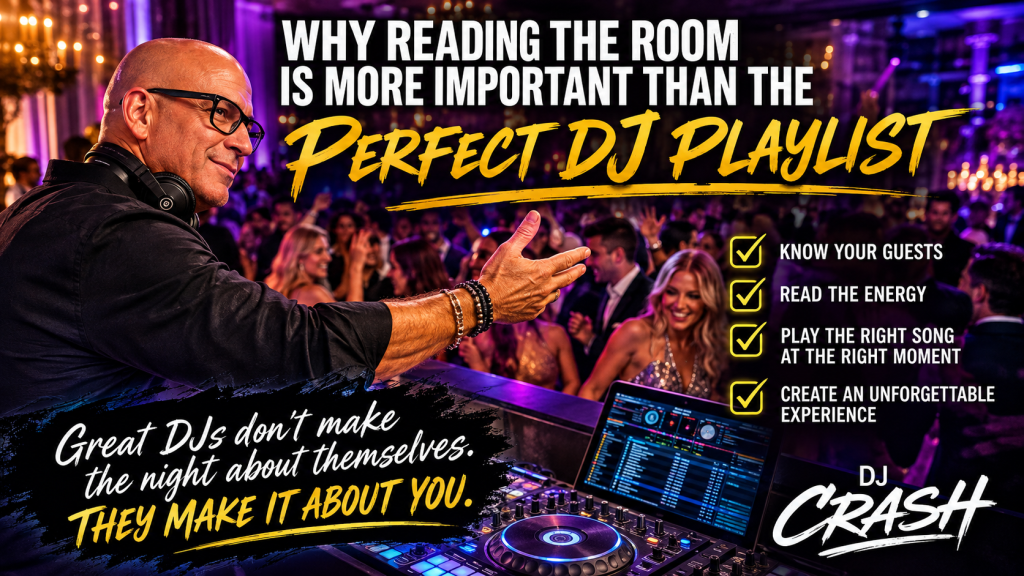
Clients often ask DJs about playlists.
What songs do you play? Can we give you a request list? How many songs should we choose? What genres work best? Should we create a Spotify playlist?
Those are all reasonable questions.
But after more than 30 years of DJing weddings, corporate events, hotels, nightclubs, mitzvahs, private parties, galas, and special events, I can tell you something that may surprise you:
The playlist is not the most important part of a successful event.
Reading the room is.
A DJ can arrive with thousands of incredible songs and still lose the dance floor. Another DJ can work with essentially the same music and create one of those nights where nobody wants to leave.
The difference usually isn’t the music library.
It’s knowing what to play, when to play it, how long to stay with it, and when to change direction.
That’s the part of DJing you can’t put into a playlist.
A Playlist Can’t See Your Guests
A playlist is created before the event.
The party happens in real time.
That’s an enormous difference.
Imagine you’ve planned a corporate reception and selected sophisticated background music for cocktails. That’s a great starting point.
But what happens when 150 guests arrive already energized from a conference?
What happens when the room is much younger than expected?
What happens when people begin dancing an hour earlier than planned?
The playlist doesn’t know.
The DJ should.
Every event develops its own personality. My job is to recognize that personality as quickly as possible and work with it rather than forcing the evening into a predetermined musical formula.
What Does “Reading the Room” Actually Mean?
People in the entertainment business use that phrase constantly.
But what does it actually mean?
For me, reading the room means paying attention to dozens of small signals simultaneously.
I’m watching who’s dancing.
I’m also watching who’s almost dancing.
There’s a difference.
I’m watching the tables.
I’m watching the bar.
I’m noticing whether guests are talking comfortably or beginning to look toward the dance floor.
I’m watching age groups.
I’m noticing which songs get people singing even if they haven’t started dancing yet.
I’m looking at whether people are leaving the dance floor because they dislike a song—or because they simply need another drink.
Those details matter.
Sometimes the biggest clue isn’t the people dancing.
It’s the people standing around the edges waiting for the right invitation.
One song can provide it.
The First Dance-Floor Song Isn’t Always the Biggest Song
One of the easiest mistakes for an inexperienced DJ to make is going too big too early.
Suppose you have five songs you absolutely know can explode a dance floor.
Playing all five in the first 20 minutes might feel successful.
But what happens two hours later?
You’ve already spent your best ammunition.
A great night has an arc.
You build anticipation.
You create peaks.
You give people moments to recover.
Then you build again.
It’s similar to telling a story. If every scene is the climax, eventually nothing feels exciting.
Experienced DJs understand pacing.
Different Generations Require Different Strategies
Some of my favorite events involve several generations in the same room.
Grandparents.
Parents.
Teenagers.
Twenty-somethings.
Thirty- and forty-somethings.
Every generation has music attached to important periods of its life.
The challenge isn’t simply playing something for everyone.
The real skill is finding the songs that connect those generations.
That’s where experience becomes extremely valuable.
There are records that can bring three generations onto the same dance floor.
There are others that might completely divide the room.
Neither is necessarily bad.
The question is when to use each one.
Sometimes I’ll spend 20 minutes focusing heavily on one demographic because I can see that they’re ready.
Then I’ll use a crossover song to bring another group into the dance floor.
Then another.
Eventually, you aren’t managing separate groups anymore.
You’ve created one party.
Corporate Events Require a Different Kind of Reading
Corporate events are particularly interesting because guests often arrive with completely different expectations.
Some are there to network.
Some want dinner.
Some are celebrating.
Some can’t wait to dance.
Some are attending because their boss told them to.
That means the DJ has to understand the purpose of the event before trying to create nightclub energy.
A product launch isn’t the same as a holiday party.
An awards dinner isn’t the same as an employee celebration.
A convention reception isn’t the same as an afterparty.
Music should support the objective.
At a networking reception, success might mean creating energy without interfering with conversation.
At a company holiday party, success might eventually mean getting the CEO and the newest employee onto the same dance floor.
Those are very different jobs.
Hotels and Luxury Events Require Restraint
Luxury hospitality taught me another important lesson:
Sometimes the best DJing is almost invisible.
In a hotel lobby, rooftop, cocktail reception, pool environment, or elegant dinner, the music shouldn’t always demand attention.
Sometimes it should simply make the space feel better.
That’s a very different skill from packing a nightclub dance floor.
You need to understand volume.
Tempo.
Song selection.
Transitions.
Guest demographics.
Time of day.
Even architecture.
A sophisticated rooftop at sunset should not necessarily sound like the same rooftop at 11:30 p.m.
The environment evolves.
The music should evolve with it.
Requests Are Information
Some DJs hate requests.
I’ve never looked at them that way.
A request doesn’t automatically mean I’m going to play the song.
But it tells me something.
If three people independently request similar music, that’s information.
If someone asks for a song completely outside the musical direction of the event, that’s also information.
The key is understanding the difference between what one person wants and what the room wants.
A DJ serves the entire event.
That sometimes means playing a request immediately.
Sometimes it means waiting 30 minutes until the right moment.
Sometimes it means not playing it at all.
Timing matters as much as selection.
Don’t Panic When the Dance Floor Changes
Dance floors breathe.
People dance.
They get drinks.
They use the restroom.
They talk to friends.
They come back.
An inexperienced DJ can see 15 people leave the dance floor and panic.
Suddenly they’re switching genres every 60 seconds trying desperately to bring everyone back.
That usually makes things worse.
Experience teaches you to recognize the difference between a natural dip and a musical problem.
Sometimes you don’t need to change anything.
You simply need to trust the room.
The Song Before the Song Matters
One of the most overlooked elements of DJing is sequencing.
A great song played at the wrong moment can fail.
The same song played 30 minutes later can explode.
Why?
Because the song before it prepared the audience.
And the song before that prepared them for that one.
Great DJing is about creating relationships between records.
Tempo matters.
Era matters.
Genre matters.
Lyrics matter.
Energy matters.
Familiarity matters.
Sometimes the perfect transition isn’t between two songs that sound alike.
It’s between two songs that make people feel alike.
That’s an important distinction.
Technology Can’t Replace Judgment
DJ technology today is extraordinary.
We have access to enormous music libraries, sophisticated controllers, streaming platforms, intelligent software, stems, effects, automated recommendations, and increasingly powerful AI tools.
I use technology.
I appreciate technology.
But technology still doesn’t replace judgment.
Software can tell you the BPM.
It can identify the key.
It can recommend another song with similar characteristics.
What it can’t reliably tell you is that the woman at table seven has been singing every ’80s song and that six of her friends are about to follow her onto the dance floor.
That’s the human part of DJing.
And it’s one of the reasons experienced DJs still matter.
Preparation Still Matters
None of this means playlists are useless.
Quite the opposite.
Preparation gives you the foundation that allows you to improvise confidently.
Before an event, I want to understand the client.
I want to know important songs.
I want to know what they dislike.
I want to understand the guest demographics.
I want to know the schedule.
I want to understand the venue.
But I treat that information as a map.
Not handcuffs.
Once guests arrive, the real event begins.
The Best DJs Are Constantly Making Decisions
When people watch an experienced DJ, it can look easy.
That’s usually a good sign.
Behind that appearance are hundreds of decisions throughout the night.
Do I stay with this genre?
Do I increase the tempo?
Do I change generations?
Should I play the obvious hit now or save it?
Should I take the request?
Is the room ready to dance?
Do they need another familiar song?
Should I lower the volume?
Should I let this song play longer?
Should I get out of the way and let the moment happen?
Most guests will never notice those decisions.
They shouldn’t.
They should simply feel like the night flowed naturally.
Final Thoughts: Hire the DJ, Not the Playlist
If you’re planning a wedding, corporate event, hotel reception, mitzvah, gala, private party, or any other celebration, definitely talk to your DJ about music.
Share songs you love.
Share songs you hate.
Give them insight into your guests.
But don’t judge a DJ solely by whether they can build the perfect playlist in advance.
Ask a more important question:
Can this person read a room?
Because once your event begins, your playlist isn’t hosting the party.
Your guests are.
And after more than three decades behind the decks, I’ve learned that the most successful events happen when a DJ stops trying to control every moment and starts paying attention to what the room is telling them.
The best playlist is the one that changes when the party changes.
— DJ Crash
30+ Years of Professional DJ & Event Experience
Weddings • Corporate Events • Hotels • Mitzvahs • Private Parties • Nightclubs • Luxury Events
Meta description: An experienced professional DJ explains why reading the room, understanding guests, pacing the dance floor, and choosing the right song at the right moment matter more than creating the perfect playlist.
Target search phrases: professional event DJ, how DJs read the room, DJ playlist for events, how to choose a DJ, corporate event DJ, wedding DJ playlist, luxury event DJ, private party DJ, what makes a great DJ.


